
This is a very different place from Delhi, Bill and I are traveling in our comfortable car through the very rural landscape of Arunachal Pradesh which we crossed into earlier today from Assam. We passed a sign that said Indo-Tibetan Border Military Force, indicating the large Indian army presence here, sufficiently close to the China border to require restricted permits. And close by we saw another sign on the road warning “Elephant Crossing” although the only quadrupeds we saw in the last few days were cows, goats, dogs, and a very few cats.
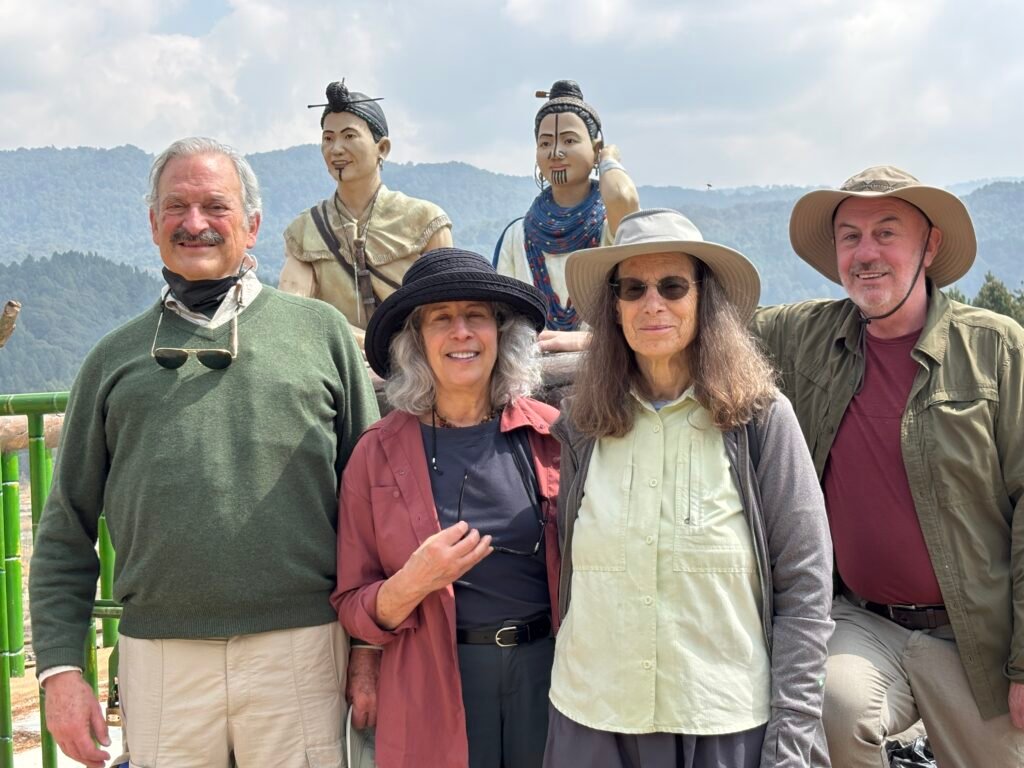
Nancy and Jim, our travel mates from Portland, were a day behind as Jim needed an urgent care visit to a Delhi hospital for a respiratory illness but they joined us last night in Tezpur and are doing well. They are intrepid travelers as this is an unusual itinerary for anyone coming to India for the first time. In fact, in our 3 days here we have seen only one other European tourist
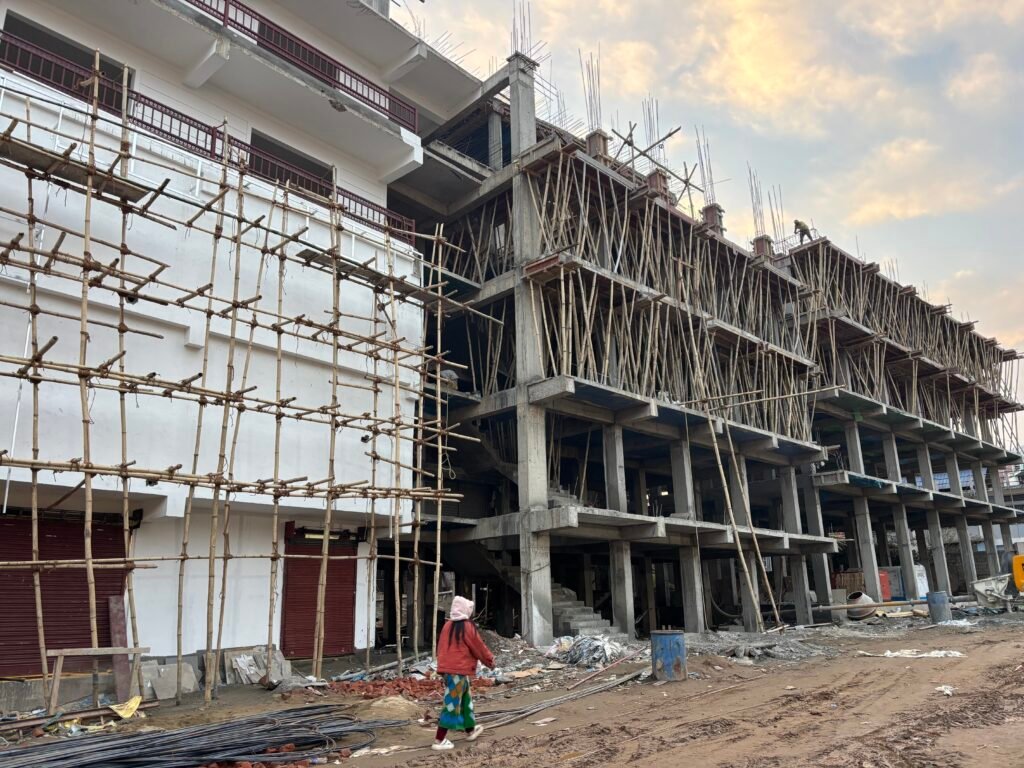
.Our arrival by plane into Assam at Guwahati was a surprise to us as we expected a quiet rural environment but found a large spread out and bustling metropolis with all the commercial displays and motifs of modern India, large brightly lit stores and many-storied buildings under construction. Throughout our travels here, on every street, there are numerous partially complete reinforced concrete multi-leveled post and slab construction sites on which we invariably see the top floor still supported by a multitude of bamboo shoring props. Bamboo continues as the main scaffolding material here. Bill says there will be infill brick to rigidify the non-stable rectilinear geometry of the structures – important in a location which is very earthquake prone – and then a final layer of plaster. Large parts of Assam were destroyed in an earthquake in 1897 and then again in 1950 so earth movement is a serious consideration for any construction.
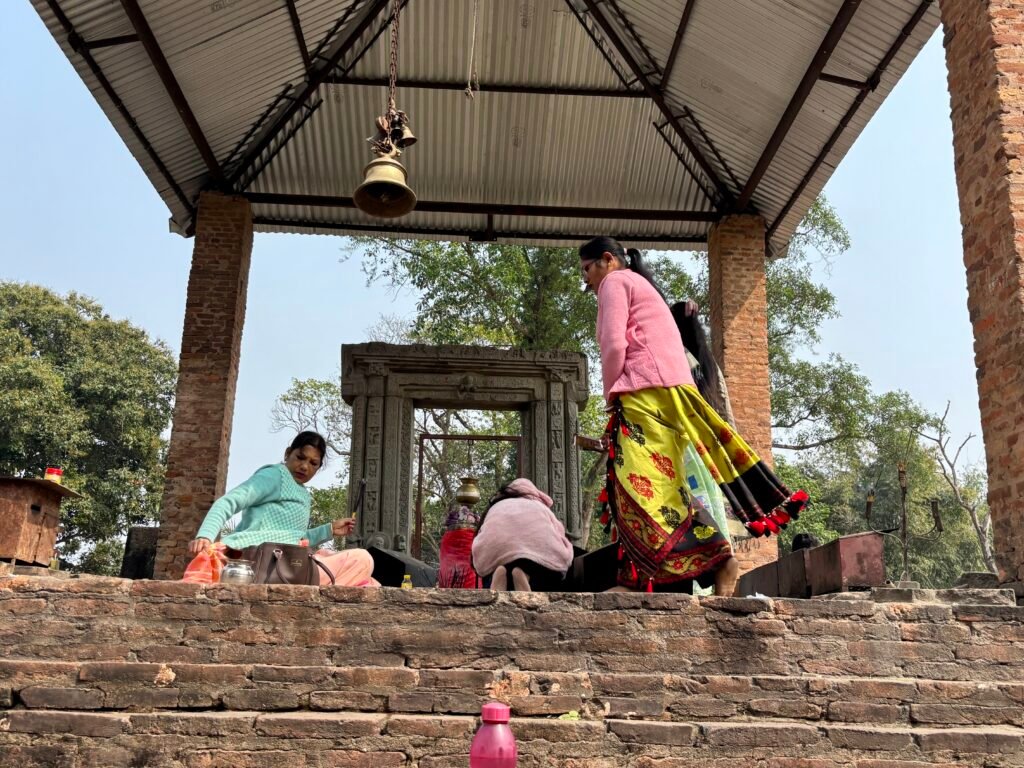
During our first day with a guide, Bill and I visited several locations in Tezpur, Assam, founded by the British and once an important trading post on the Brahmaputra River. The Da-Parbatia is a 6th century ancient site of a Shiva Temple with a carved stone gate and lingam which is still being worshipped today. It was a Monday which is when woman come to worship to ask for protection and prosperity for their husbands and the unmarried pray for a good match and it was active with chanting and offerings by the faithful women. We also visited a large park filled with local families enjoying the beautiful weather and decorated with the remains of ancient monuments piled up in a hodgepodge manner. Very tired, we also made a quick stop at the main Hindu temple in the city, rebuilt after one of the great earthquakes. It is now overlooked by a 7-story new apartment complex, with the old oil lamps being lit at the same time as modern life goes on next door.
The four of us are now in Ziro, Arunachal Pradesh, at about 5,000 feet and cool at night. We are travelling with 2 cars, 2 drivers and 1 guide. This is a tribal culture, with numerous clans throughout a fertile valley. There are 6 major cultural groups, each in their own set of villages and we visited two of them, the Nyishi and the Apatani. I was told the main difference between them is the Nyishi live in the highlands and burn forest for their new cultivation and when it is no longer fertile, move on to other land, while the Apatani live in the valley and work the paddy rice fields each year. However, global warming it making it more difficult for all of them to be ensured a proper crop.
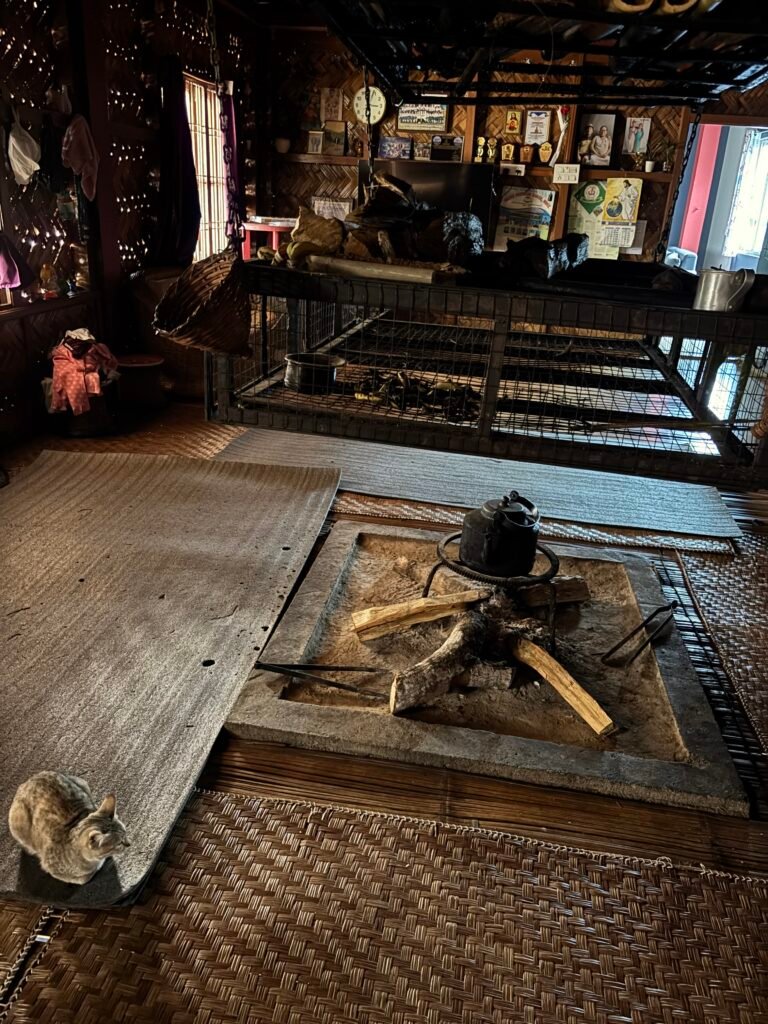
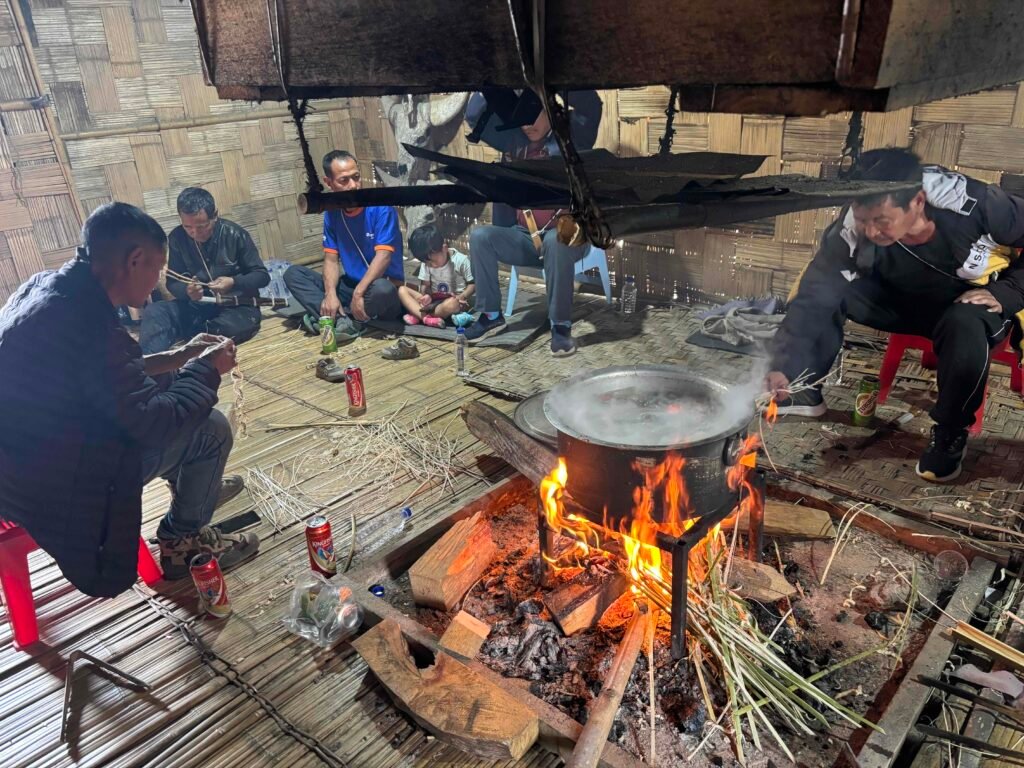
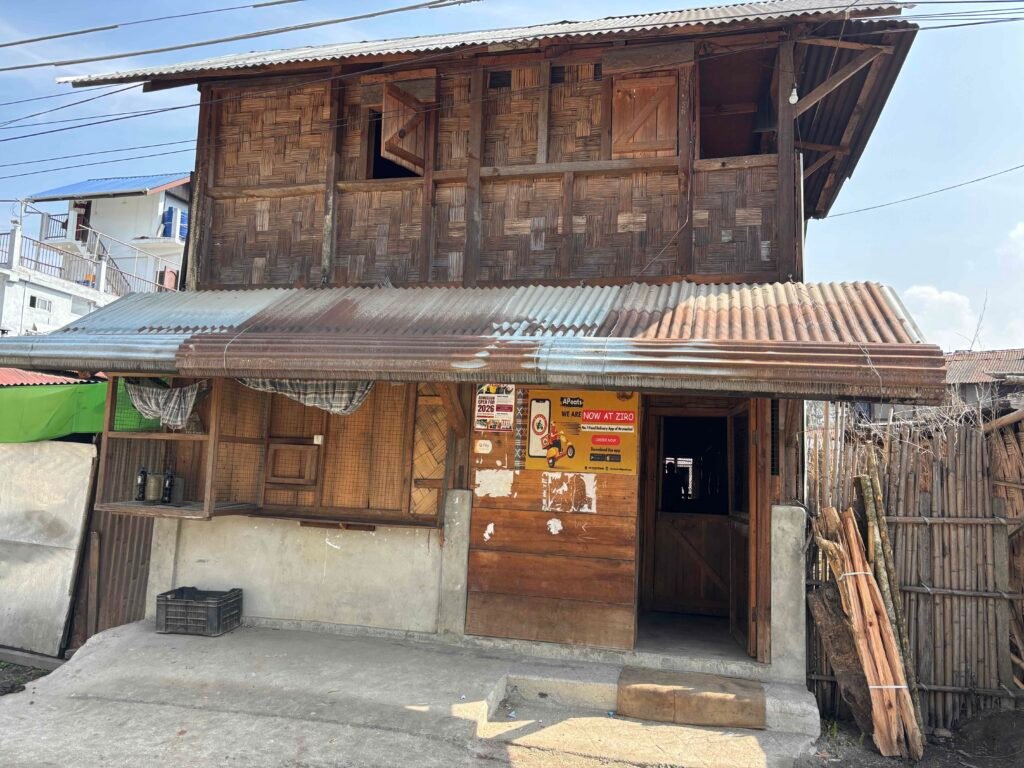
The traditional Nyishi communal house had bedrooms around a central fire pit where everyone gathers for dinner. However, tucked in one room one the side is a very modern beautiful kitchen and their living room boasts a large screen and comfortable couches. It is raised off the ground to protect against floods and the flooring and the ceiling is made of bamboo, allowing smoke to drift upward and out. Our walk takes us past a number of the Nyishi houses, some almost entirely of bamboo, while nearby are modern concrete houses. There is such a sharp difference between the two types of housing styles that I wonder whether envy causes friction among neighbors.
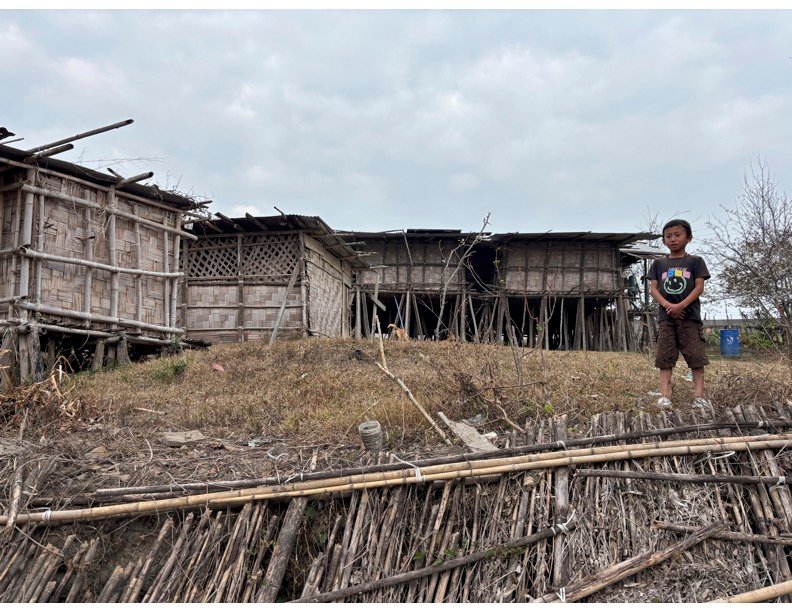
Another old custom is the Nago, or prayer hut, in which periodically the sacrifice of a monkey from the nearby forests is made to propitiate a spirit that was killed in the past by someone in the Apatani community but who then sent down an epidemic in vengeance. To prevent further harm by this spirit, certain clan members (I did not get who they are) perform an age-old ritual in a very small hut, with each clan possessing their own Nago for this purpose.
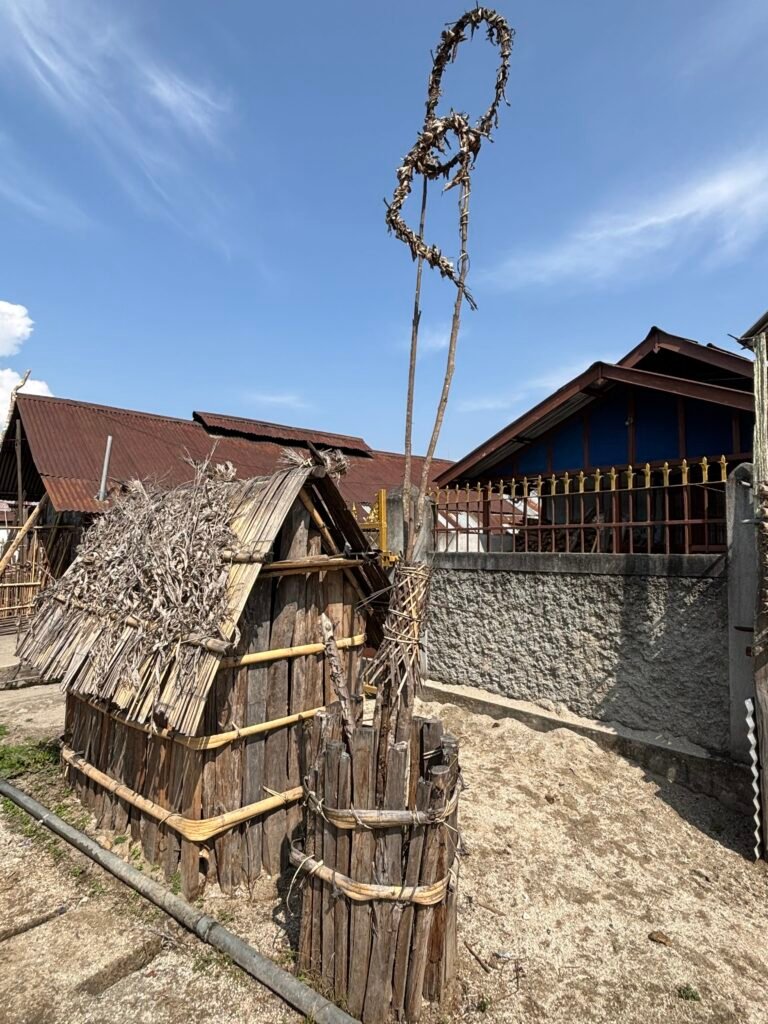
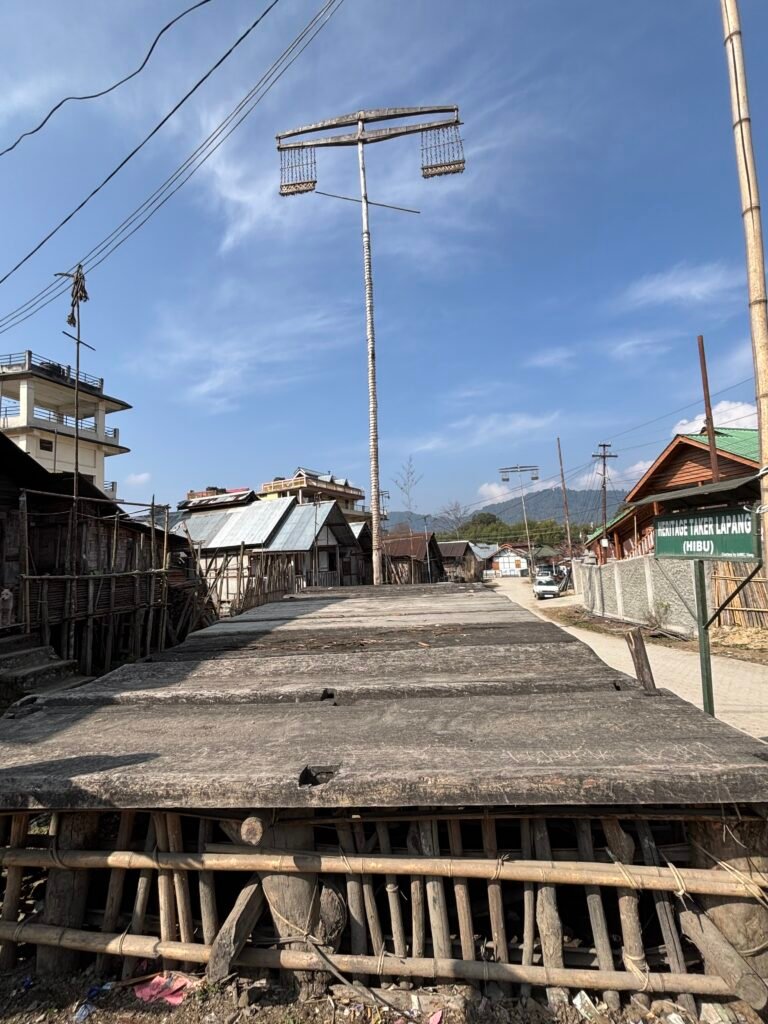
The next day we spend visiting Apatani villages, with a local guide who is from the Hong village and knows everyone. Today is special in a number of ways: for the Hindus it is Holi, the spring time celebration of color and music associates with Lord Krishna. But our exposure to that festival is limited to the loud music we hear blasting around our hotel from a local party and the sight in the city market of men with clothes stained with colored powder emblematic of the holiday. The Apatanis believe in a religion based on the sun and moon. We are privileged to see a unique Apatani event today, the raising of the Babo, or tall pole with traditional form and symbols which only happens for each clan in the village once a year. Each of the Apatani clans raises its own Babo which is placed near a dais built of teakwood called a Lapang on which the men will sit and gather through the year to discuss whatever issues arise to be resolved among them. Signs in English state that women are not allowed to sit on the Lapang. The pole itself represents womankind in some form. Smaller forms of this pole are raised at each house upon the birth of a son.
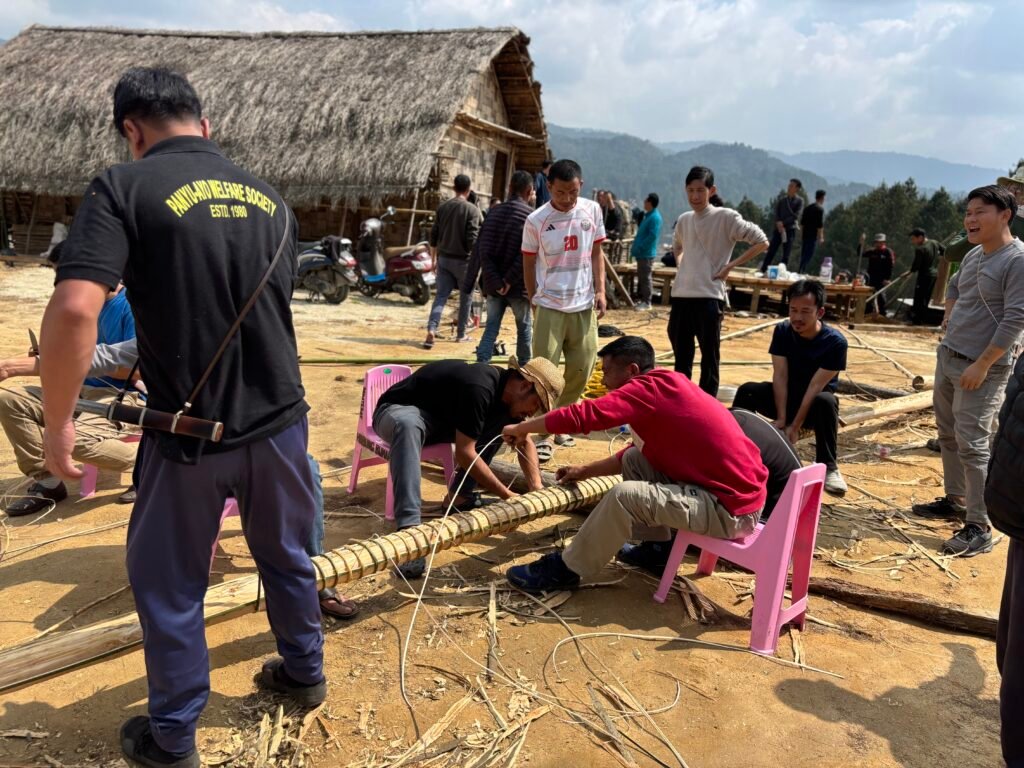
At the site of the Babo raising, we see the men wrapping cords of bamboo around the wood pole in the traditional design. Inside the traditonal house in the rear, we visit the men making the ornaments which will hang from the pole.
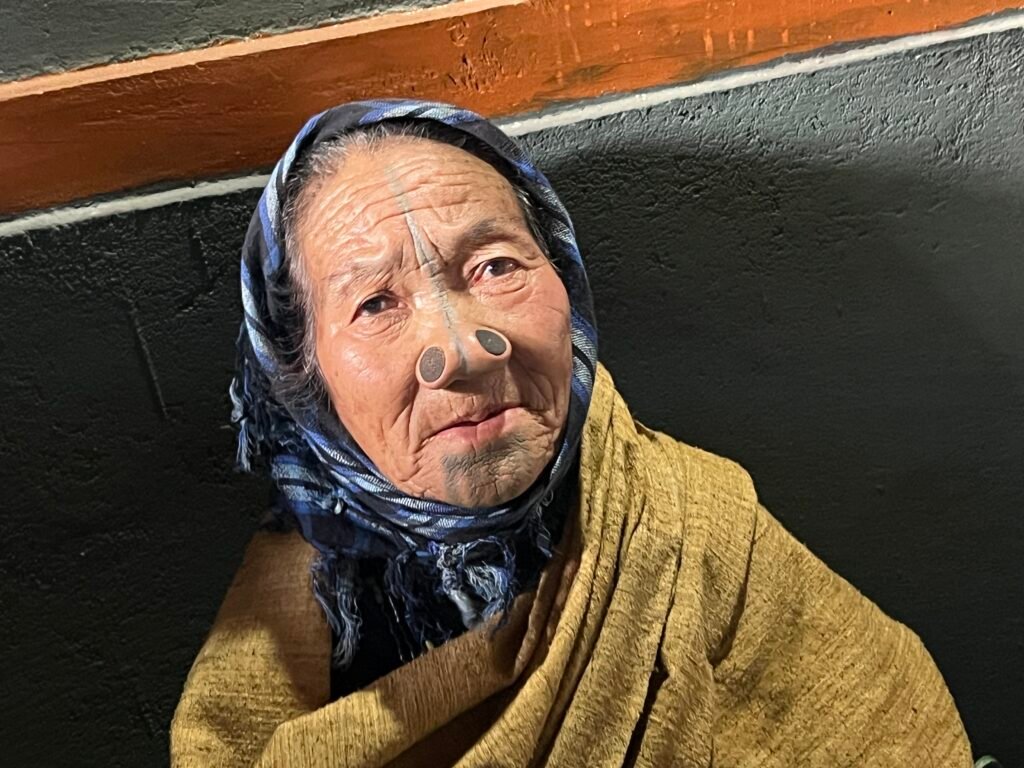
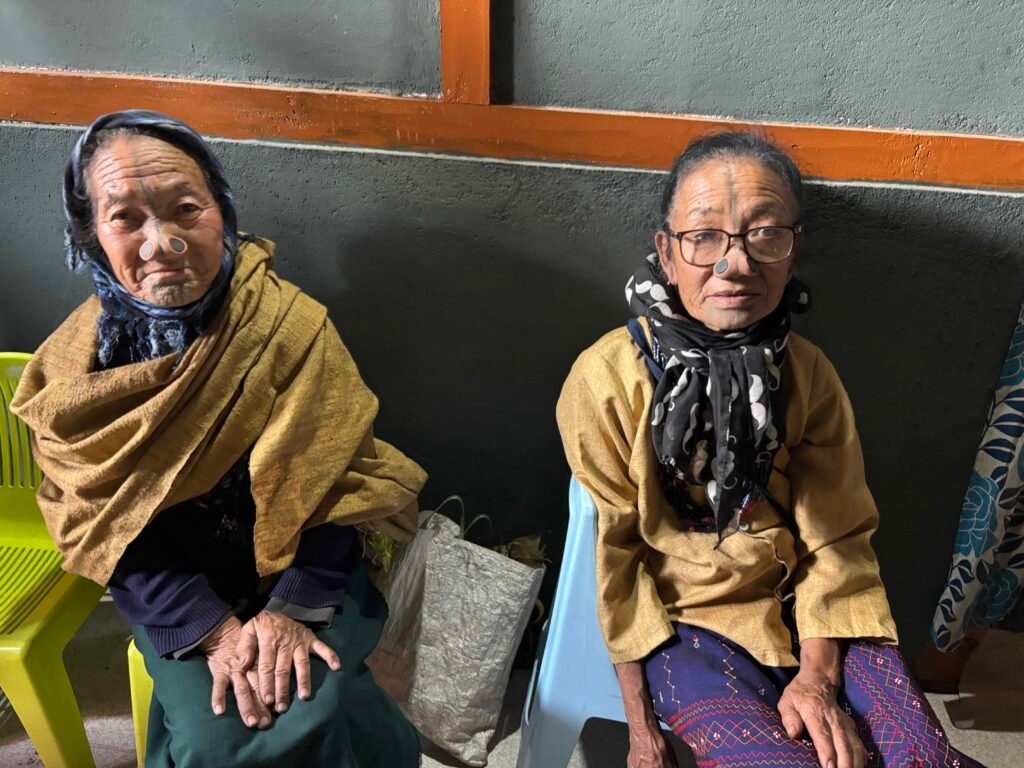
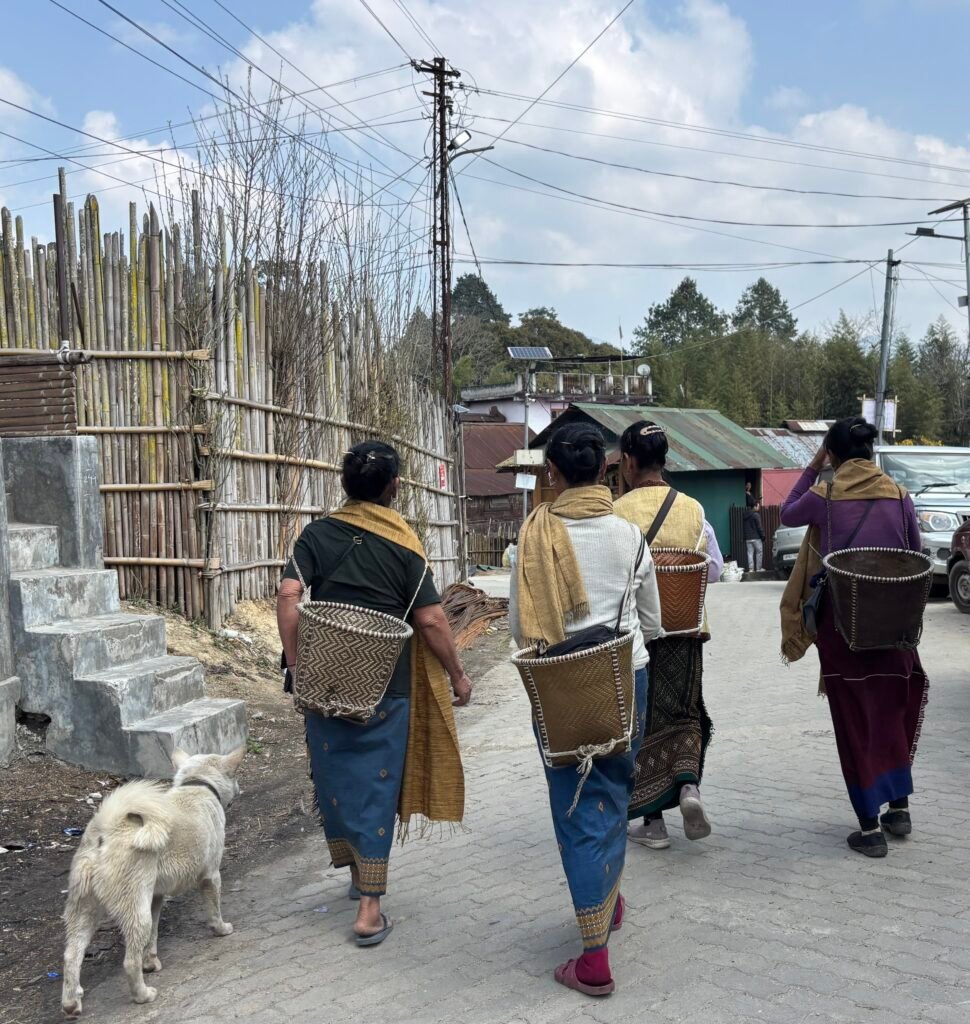
I have seen an unusually large number of dogs and cats in the Apatani villages, most of whom have collars on them and seem healthy and well-cared for. The old Apatani women themselves are known for having facial tattoos and nose plugs, which began, we are told, so that the neighboring tribes would not steal their beautiful women. This tradition was discontinued in the 1970’s, I believe, but can still be seen on many of the older women we saw in the village and at the wedding party.
Our guide tells us the clans all love each other, there is no in-fighting. And as with the Nyishi, there are very small bamboo huts which look like they are falling apart next to large beautiful modern homes and I can not but wonder with my American mindset if there is friction between people with such different ways of daily living. I went into one Apatani wood home and used their toilet, a clean squat toilet with a spigot nearby. Like the Nyishi home, it had a large communal fire pit in the center of the main room. All the floors are split bamboo and allow air to pass through them but require some care in walking upon.
We are invited to a wedding festivity today to which all the members of that clan are invited. Great vats of food and a wedding feast at which special guests speak their hopes and wishes for the couple. There are big banners announcing this wedding in the village. I asked about marriage traditions and there are no longer any arranged marriages here and there is no dowry system. Young people, who usually marry by 25, can not marry within their clan or anyone in their family. Couples initially have a wedding ceremony and then when they ave 1-2 children have another ceremony, as the one we attended, to celebrate their life together and to bless their children — and if they have none, to ask for fertility for the future.
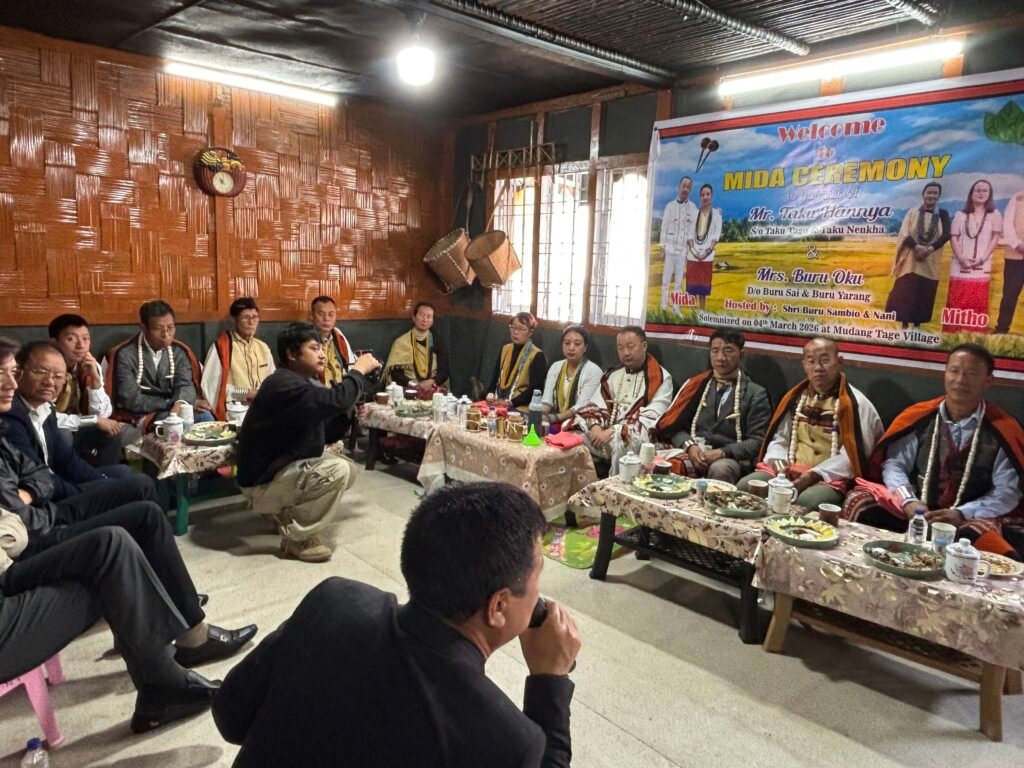
It was an amazing day. We were welcomed and greeted warmly in all places. These tribes and clans are living amazingly well with one hand steadily holding on to their traditions and the other embracing the helpful elements of the modern world. We saw many of these flimsy appearing homes with brand new cars in garages and with washing machines in outbuildings. On the surface, it truly appeared to be a cohesive loving community which we could learn from.
We ended our visit to Ziro with a visit to their market in the evening, with fresh fruits and vegetables on sale. I bought some oyster mushrooms and beets and have asked the cook at our hotel to cook them for me for dinner. I will let you now how they turn out in my next post!