
We are now on the road out of Assam and into Nagaland, home to 17 related Naga tribes, each with their own language and customs. We just passed our first elephant on the road, a domesticated working elephant, which our guide says is probably on the way to do some work in a forest. There was an empty row of toll booths with a “Stop” sign that we just whizzed through. I am told this new road was made using recycled plastic and bitumen and when finished a toll will begin to be charged. Empty fields of harvested rice paddies are on our right, with grazing goats and cows. We pass through a small village with small concrete structures interspersed with wood huts. I saw a women in her courtyard feeding 2 huge hogs. We drive through a large wildlife sanctuary, home to a certain kind of gibbon. Then on the road is a large herd of cattle walking on their own, with a randy male trying to mount a female in the middle of the road and almost causing an accident. I am told that these animals are owned by a nearby village and will walk home at the end of the day on their own.
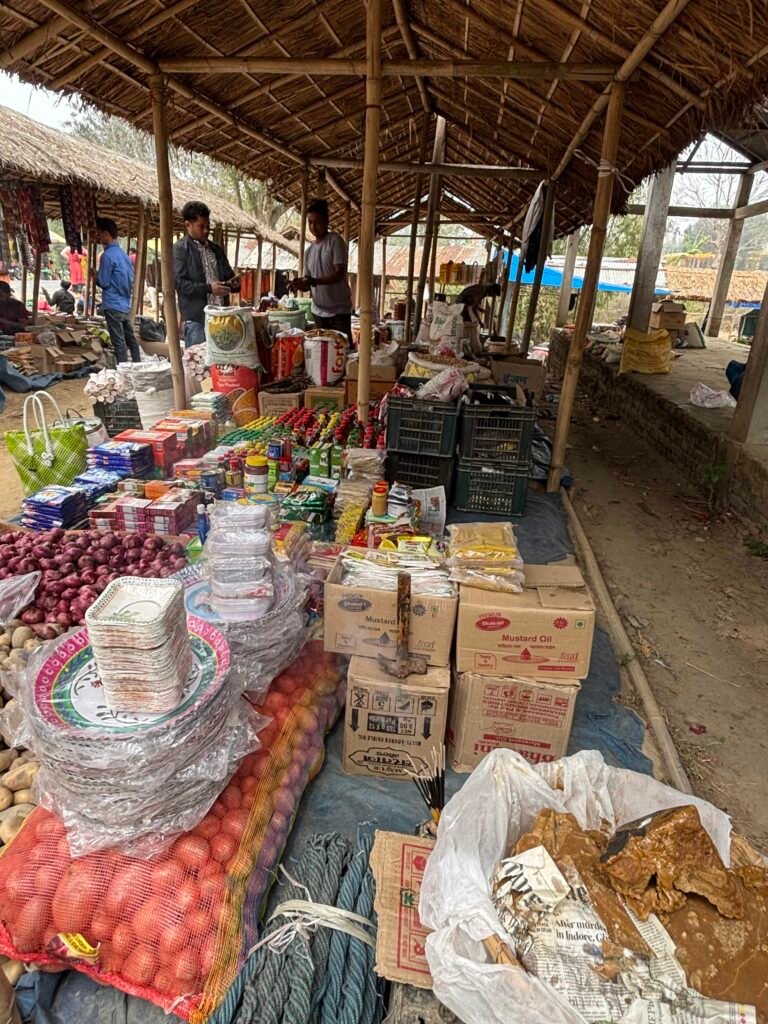
It is Saturday and as we pass a very large local outdoor weekly market I ask to stop so we can walk through it. There are a very interesting and diverse collection of goods on the ground or displayed on low wooden platforms. Aluminum pots and pans, small solar battery powered lights, large hand forged machetes and knives, mobile phone cases, coffee in bags and assortments of grains, rice, including flattened rice which I had never seen before, piles of orange jaggery sugar, bamboo baskets of dried fish of all sizes, endless shoes, women’s saris and fabric, piled up betelnuts and leaves, live chickens confined in bamboo baskets, packets of many varieties of vegetable seeds, banana blossoms and an assortment of fresh fruits and vegetables. Totally fascinating.
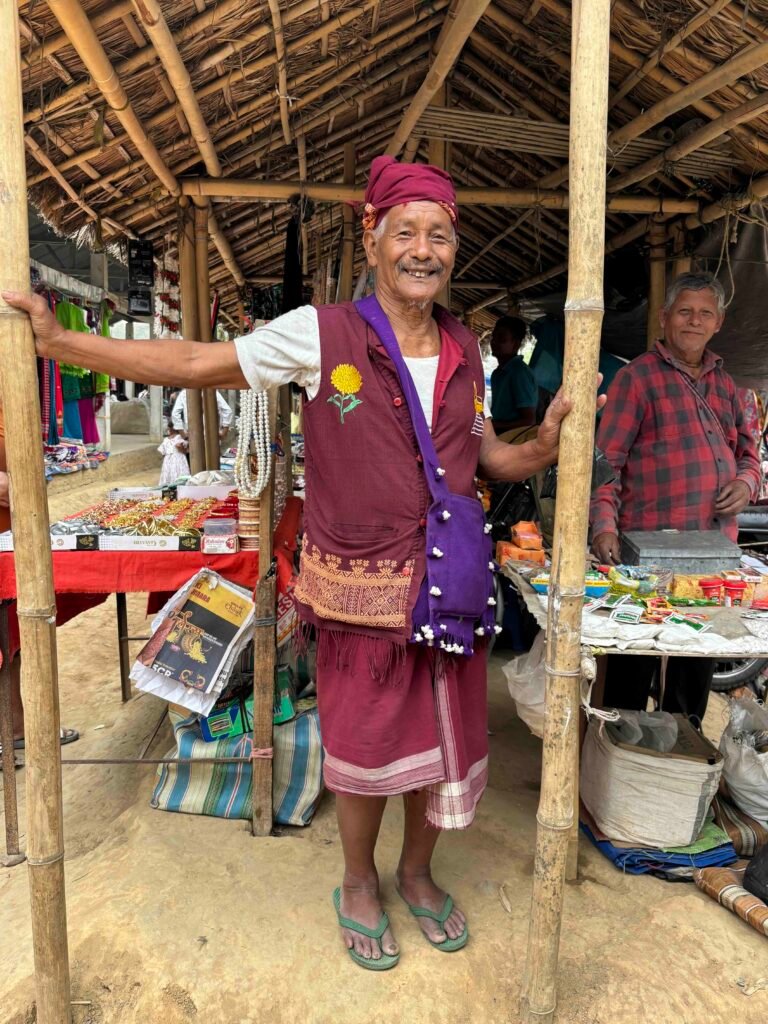
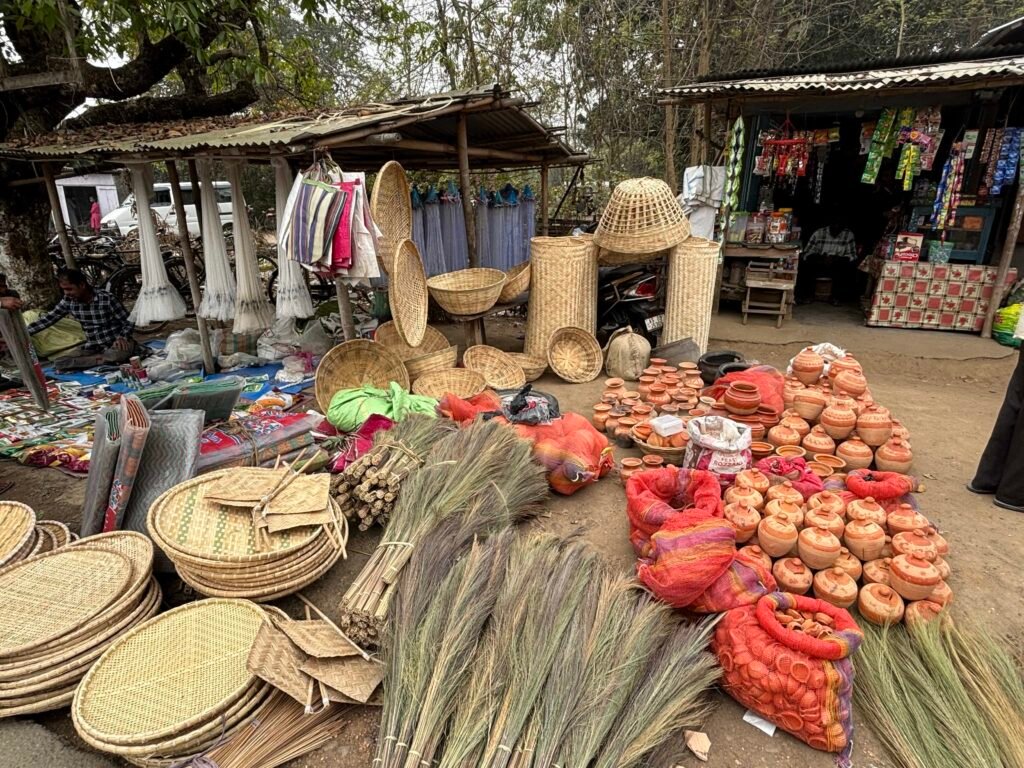
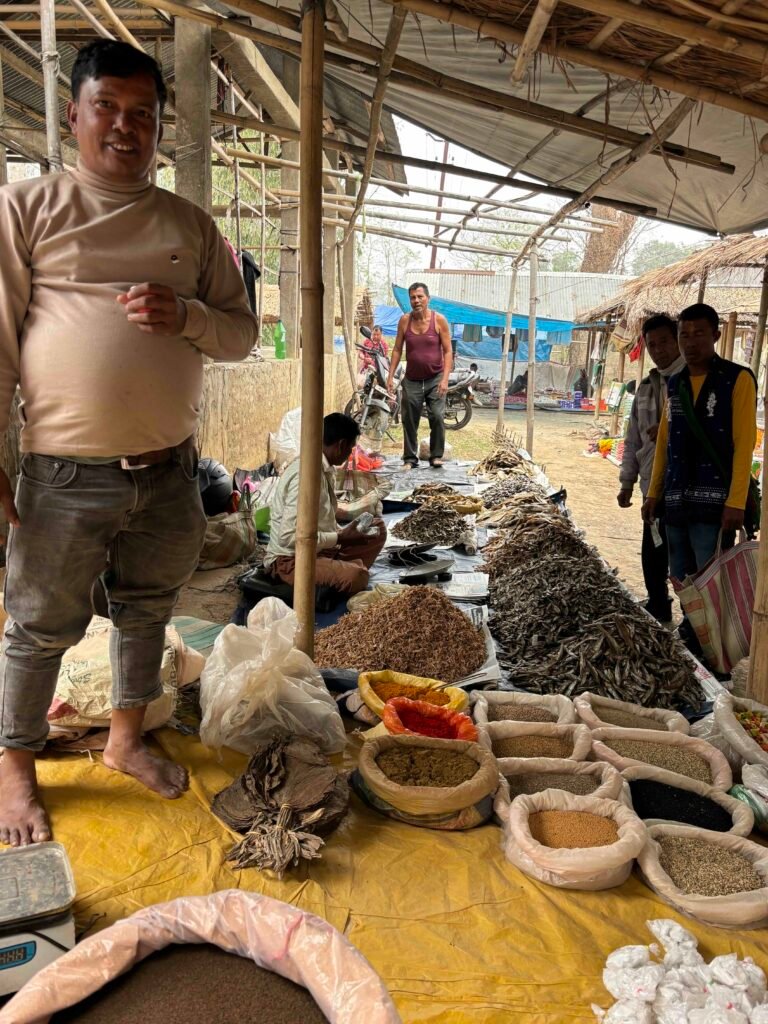
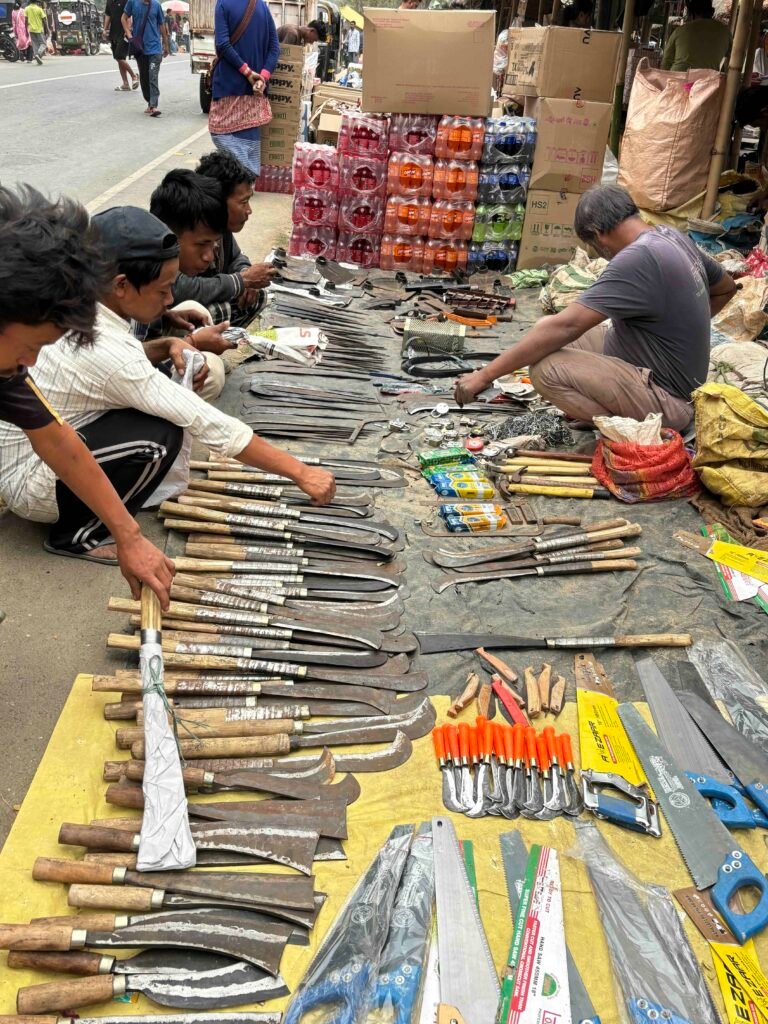
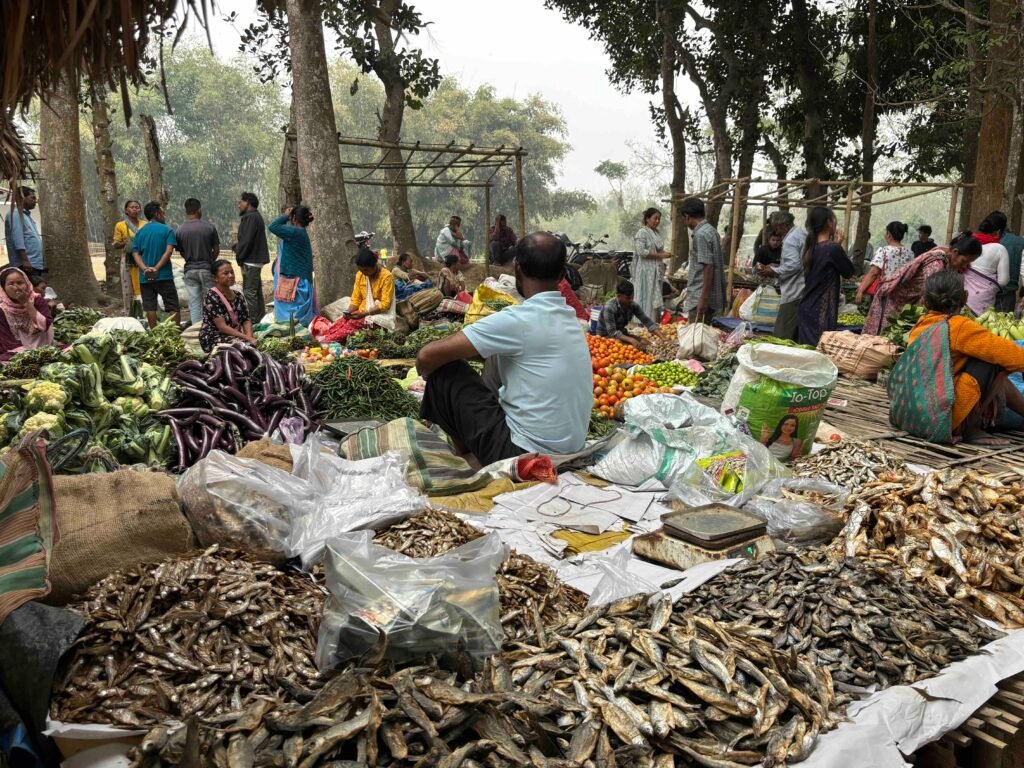
I am glad we did this because when we made our intended market stop on our itinerary in Dimapur a little later, it was totally uninteresting clothes and modern gadgets in a tight enclosed covered space and we were glad to quickly leave.
We wind up the smoky hills toward Kohima at 5,000 feet. We are told this is fog not polluted air but I can’t believe it. We see smoke and fires burning along the way and you can smell it in the air. Kohima itself is very spread out and snakes around the curves and many levels of the mountain. I am reminded of the hill stations of Northern India but this is really a city. There are many 3-5 level concrete structures both very old that look like they have never been cleaned or maintained in many decades next to many new buildings being erected with bamboo scaffolding. An endless stream of small shops and then in the center some bigger brightly lit stores. We pass several hospitals and many black and yellow taxi cabs waiting for fares. It appears to me to be a poor city by Western standards with so many shops made out of corrugated metal siding. But the people seem well fed and clothed. There are no beggars. Perhaps this is better than some U.S. cities with homeless and those in need of mental health care sleeping on the streets and in dire need of assistance.
Our Hotel Vivor is lovely and the food is excellent. Everyone seems to speak English here. This is because 87% of the population in Kohima are Christian, converted starting in the 1920’s, and given good English medium education by the missionaries. We understand that the population is divided among Catholics, American Baptists, Pentecostals, and Revivalists. Today, on Sunday, everything in town is closed and we see people dressed up walking to church, women in high heels and sleek dresses, men in suits carrying bibles in their hands. This is very different from any place else in India. And, like in Kerala, the missionaries brought not only a new religion but an increased literary rate. I had thought Kerala had the highest rate of Christians but it appears the NE Indian States have far more.
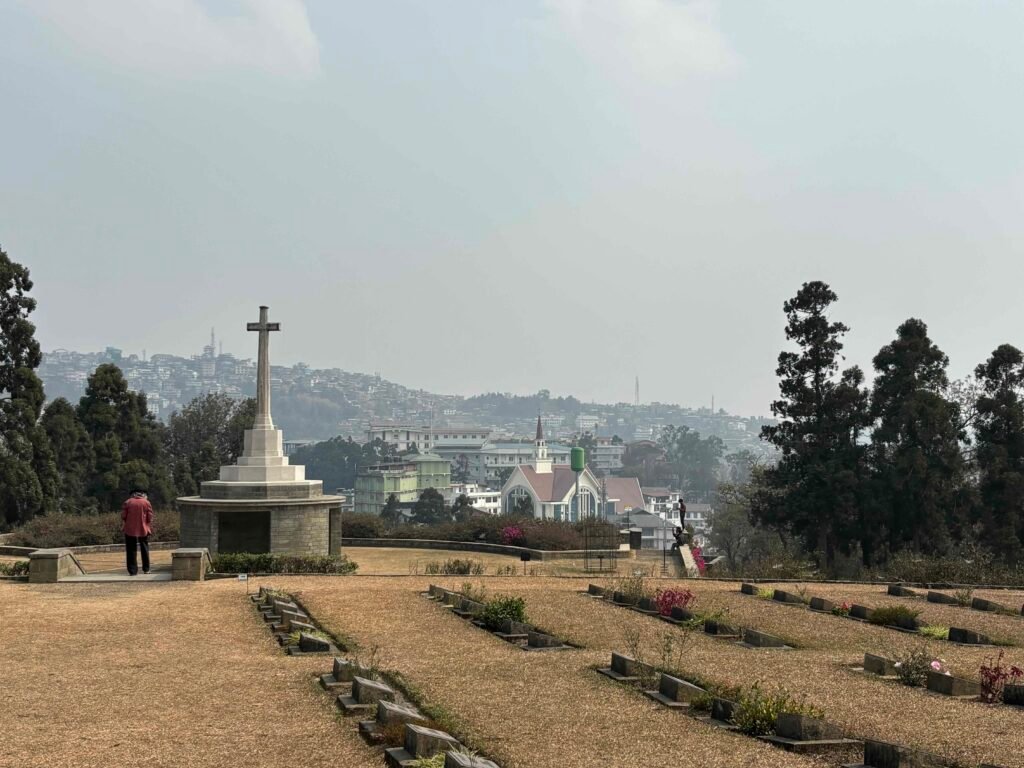
Kohima has a brutal history connected with WWII when a major battle was fought here in 1944 which stopped the incursion of the Japanese arriving from Burma into India at the cost of many lives (4,000 British/Indian and 7,000 -10,000 Japanese). We visited the beautifully laid out and maintained war cemetery in town honoring the fallen – as all wars, so very sad, the names of 20-30 year old men from every regiment in Britain, Scotland, Canada, and the more local Muslim men in a separate area as well as the cremated Hindus.
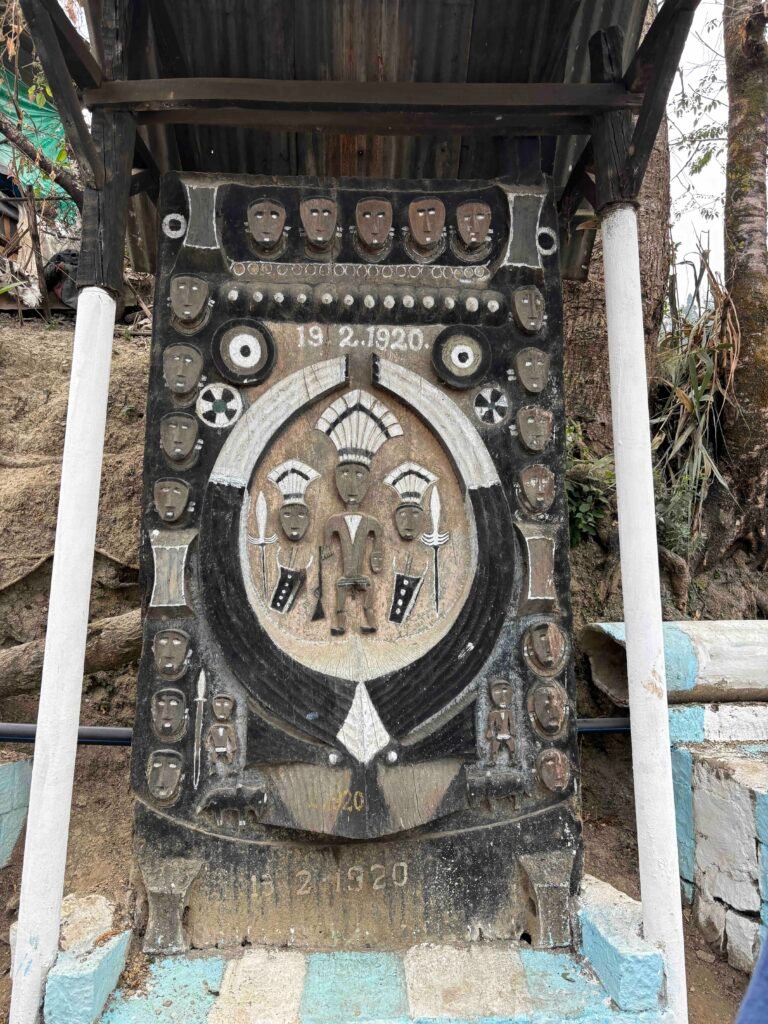
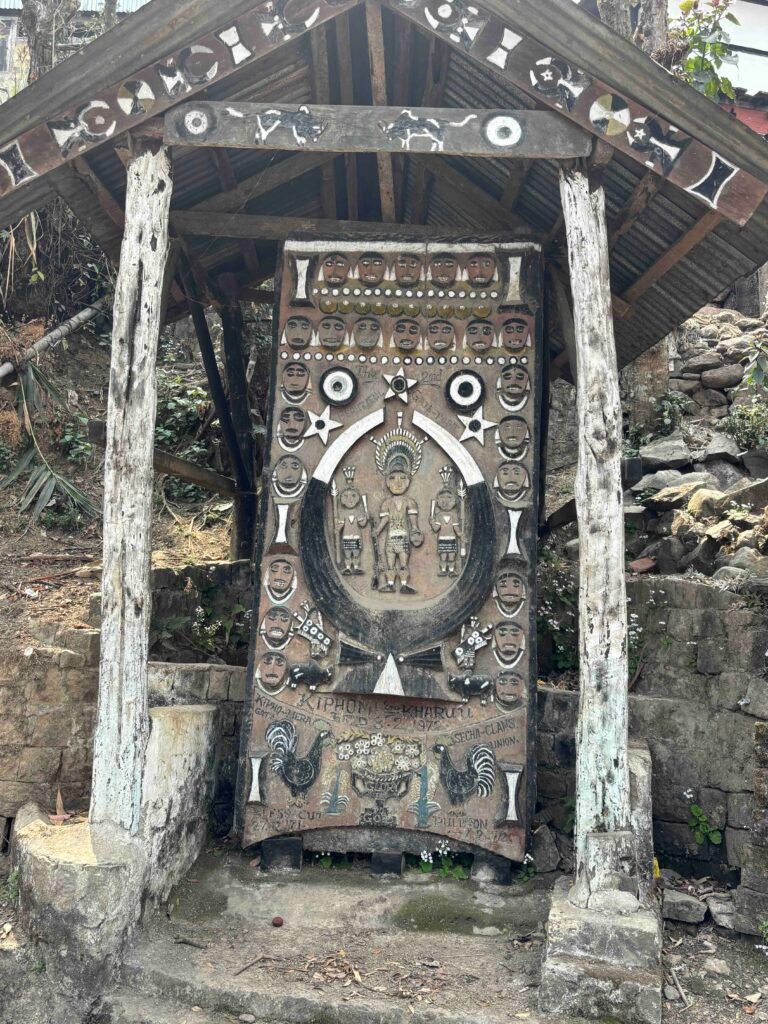
Our main destination today is several Naga Angami tribal villages. We are met by a local guide who lives in one of the subsets of the main village of Kigwema who first explains to us about the important gate to each village which was once closed and guarded 24/7 by young men. The Nagas were often being attacked by other tribes and on constant alert. With images of warriors and heads collected in battle (the earlier Nagas were head-hunters), these gates, made of one piece of heavy wood, still stand in every village although now moved to provide easy access to remind all of the past and will be replaced in a time-honored manner when necessary.
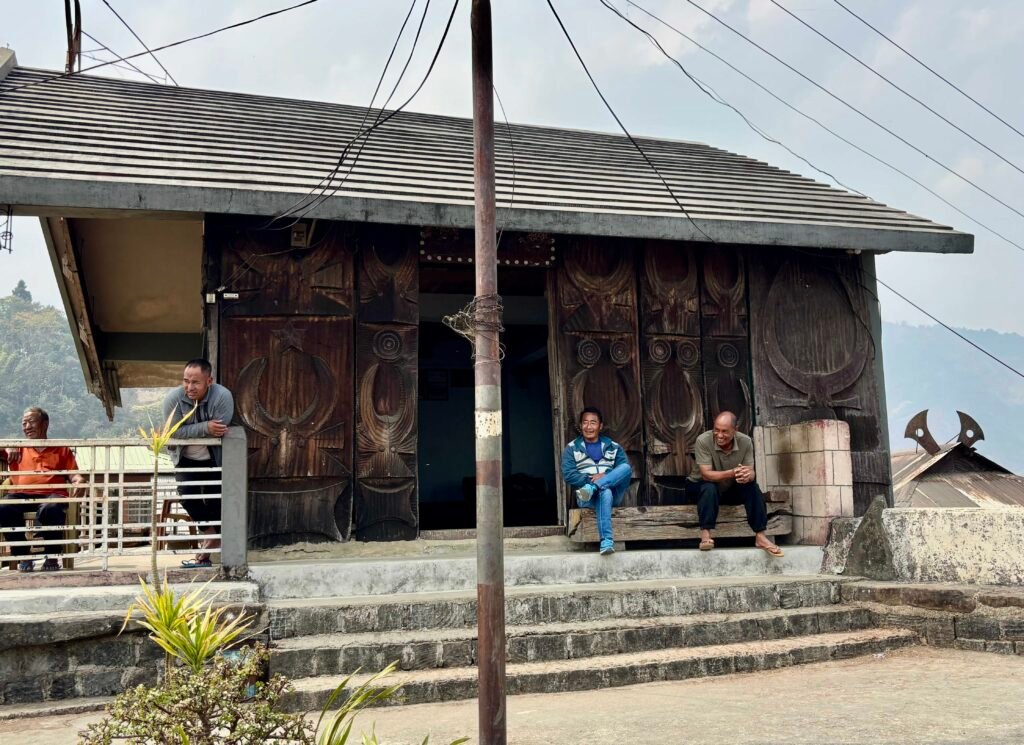
Each village also has a community area where the men meet to discuss and resolve any differences. The communal dormitories, once the home of young men reaching puberty and taught to be warriors, are now gone but their history remains.
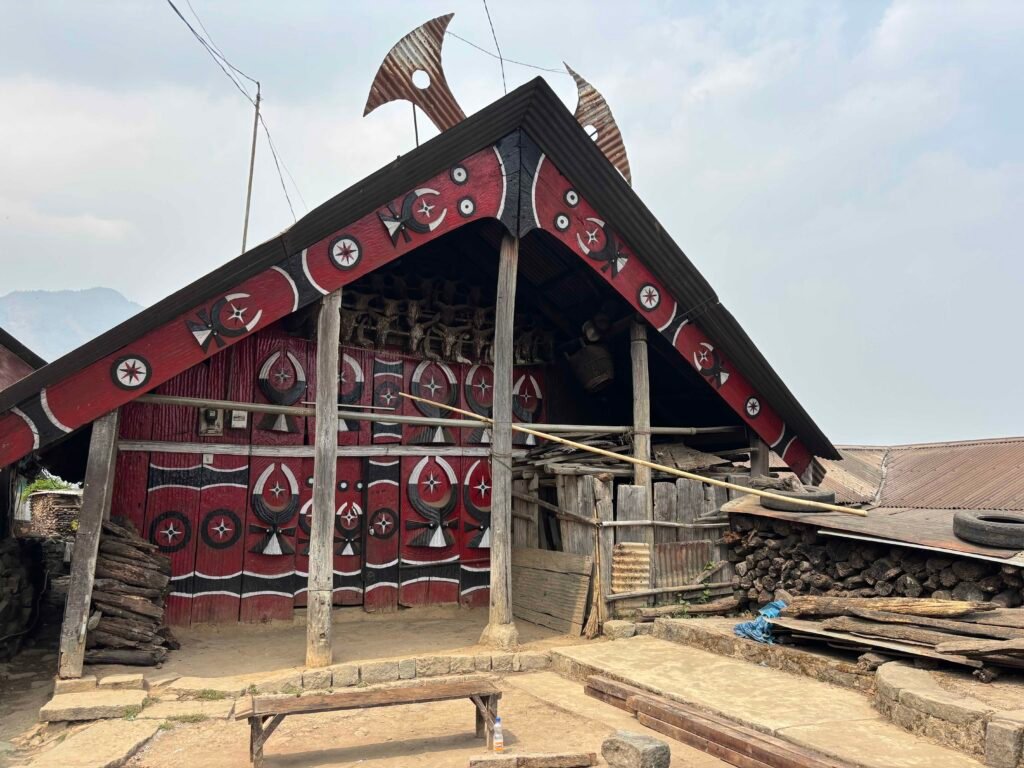
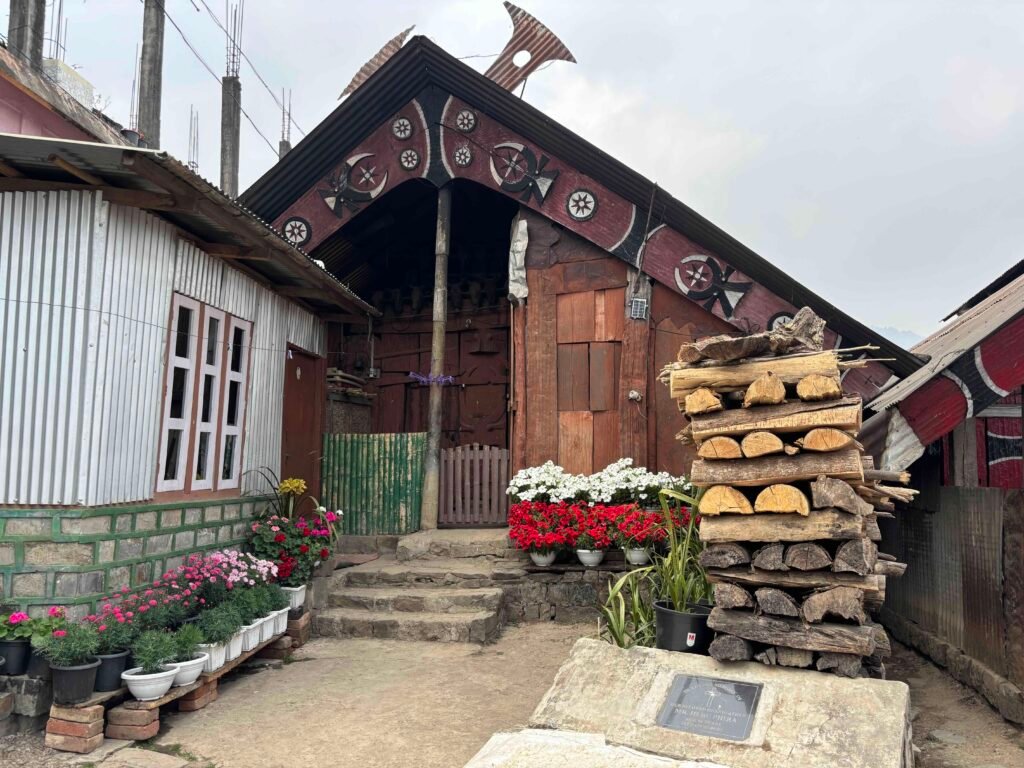
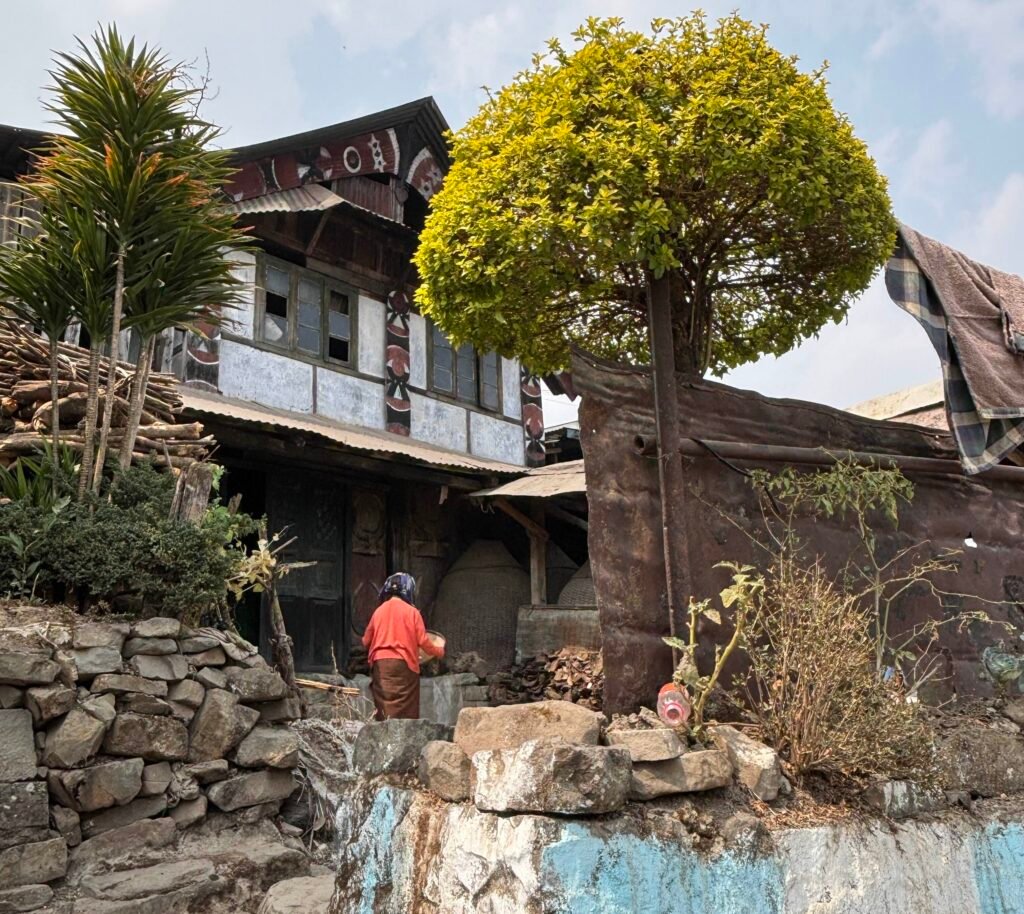
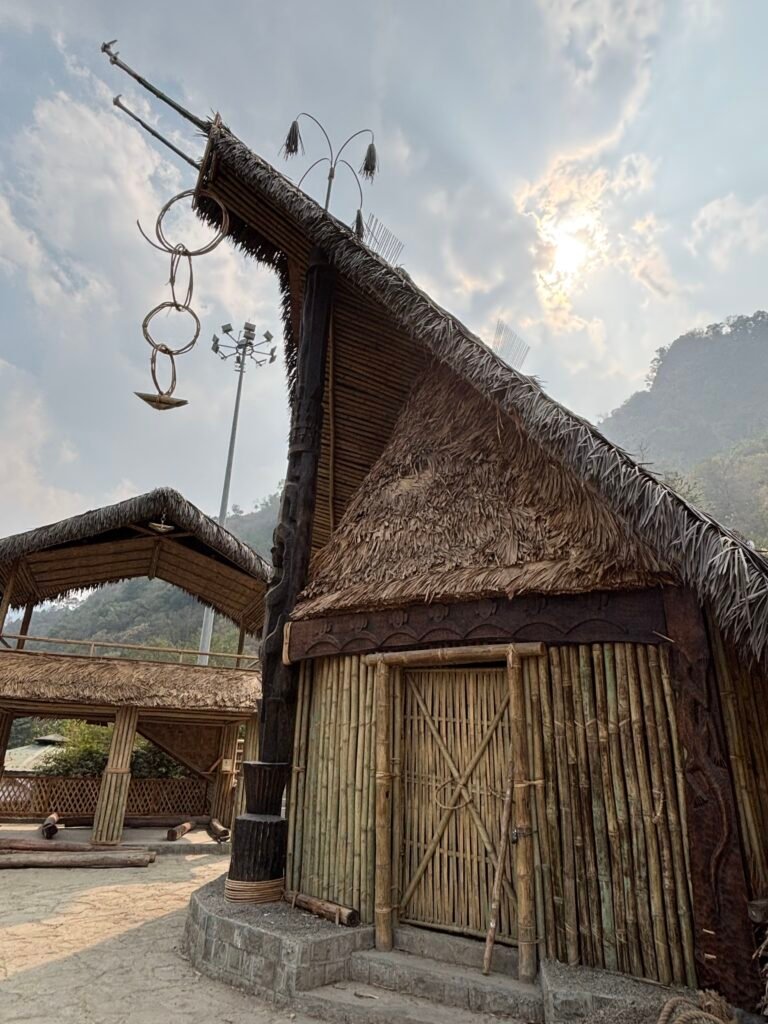
The repeating motif of some of the larger houses is the unusual roof structure below, originally painted bright red and fading over time. The curved structure on top and on the gates is a depiction of the “mithun” the sacred animal of the Nagas and the State symbol, a non-domesticated bovine species found only in tis region. Only villagers who were wealthy enough to provide a “Feast of Mary” to the entire community were allowed to erect this special kind of structure and can keep it indefinitely. There were many scattered around in different states of disrepair but still a proud mark for the family. Until recently, people buried some family members in their front yards to keep their spirits near, but recently due to crowding, cemeteries have been created for that purpose.
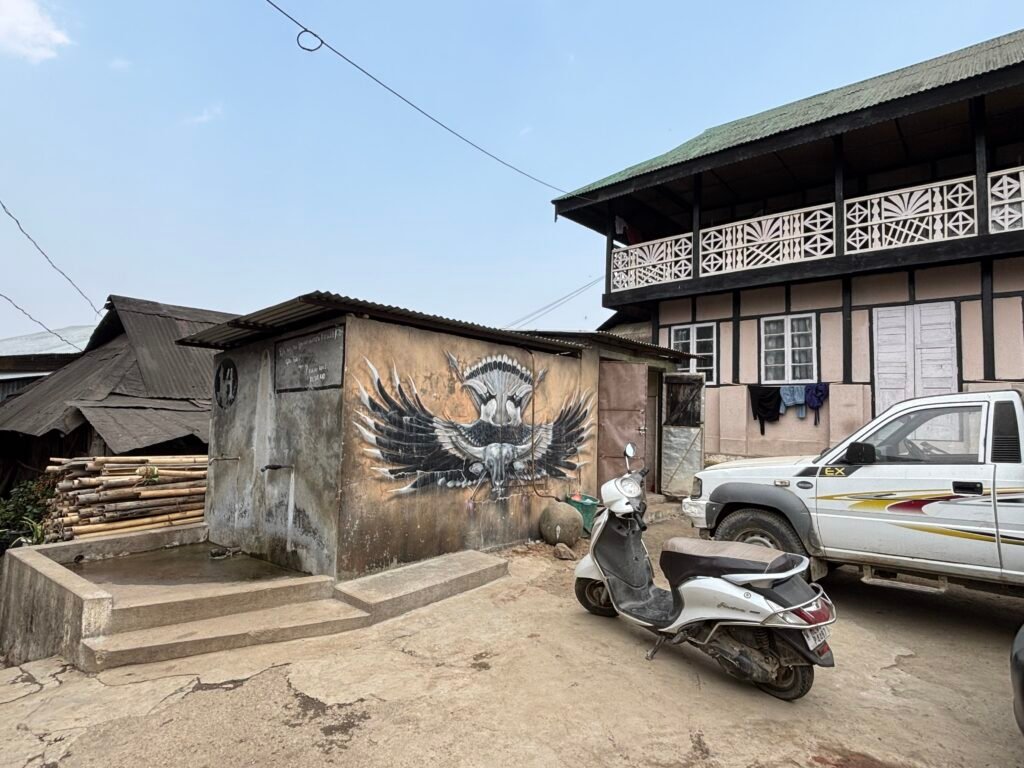
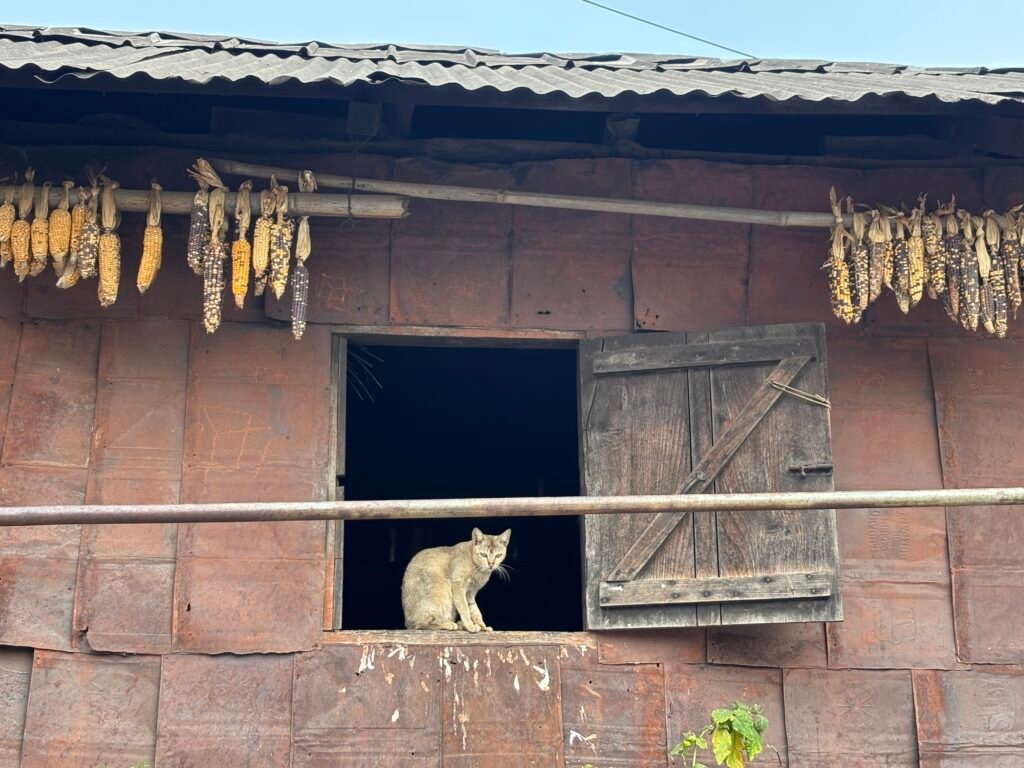
In the Jakhama Village we see greater integration of the old and new. The locally famous Hornbill bird is beautifully depicted on the side of a communal latrine below while a cat, one of the many in the area, watches over its territory nearby.
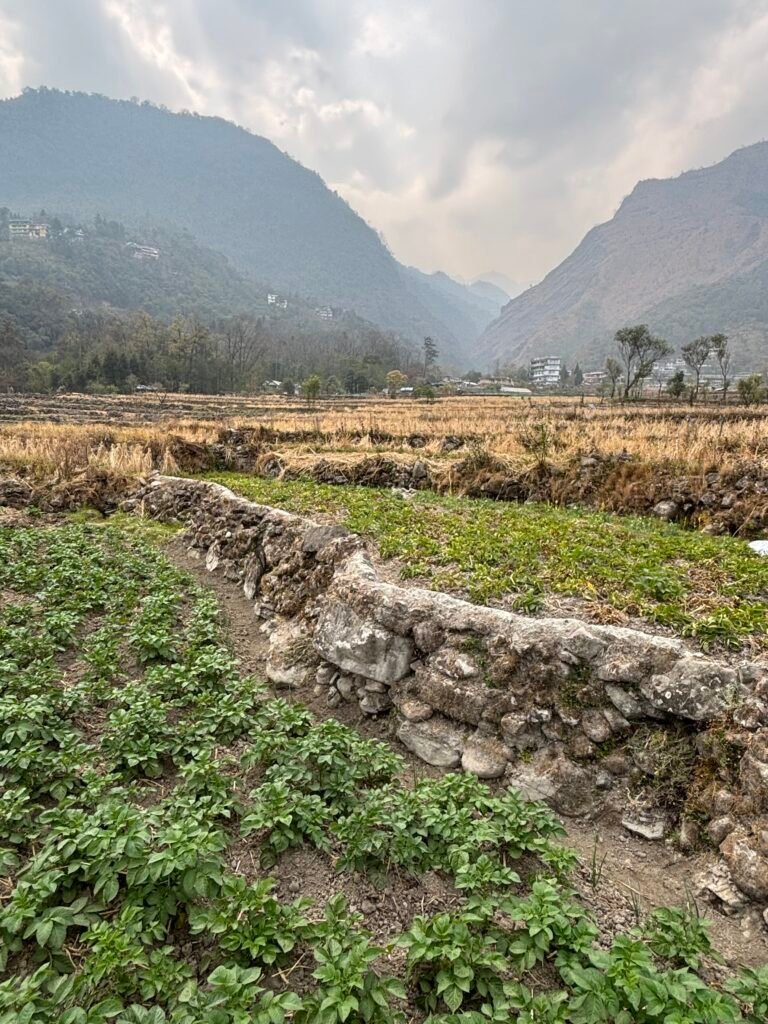
The group livelihood is mainly rice in the wet season and potatoes in the winter season, with well cared for plots carved out over generations in a beautiful valley. Our local guide says that almost 100% of these villages are Christian of some sect or another. Marriages are not arranged and can be with someone of another branch of Christianity as long as the families agree. Tall power distribution systems pass through the valley carrying electricity to the adjacent state of Imphal and I was told the local villagers are agitating against the Central Government for forcing these structures upon them in the middle of their fields. I had to work hard to get a photo avoiding these large power towers.
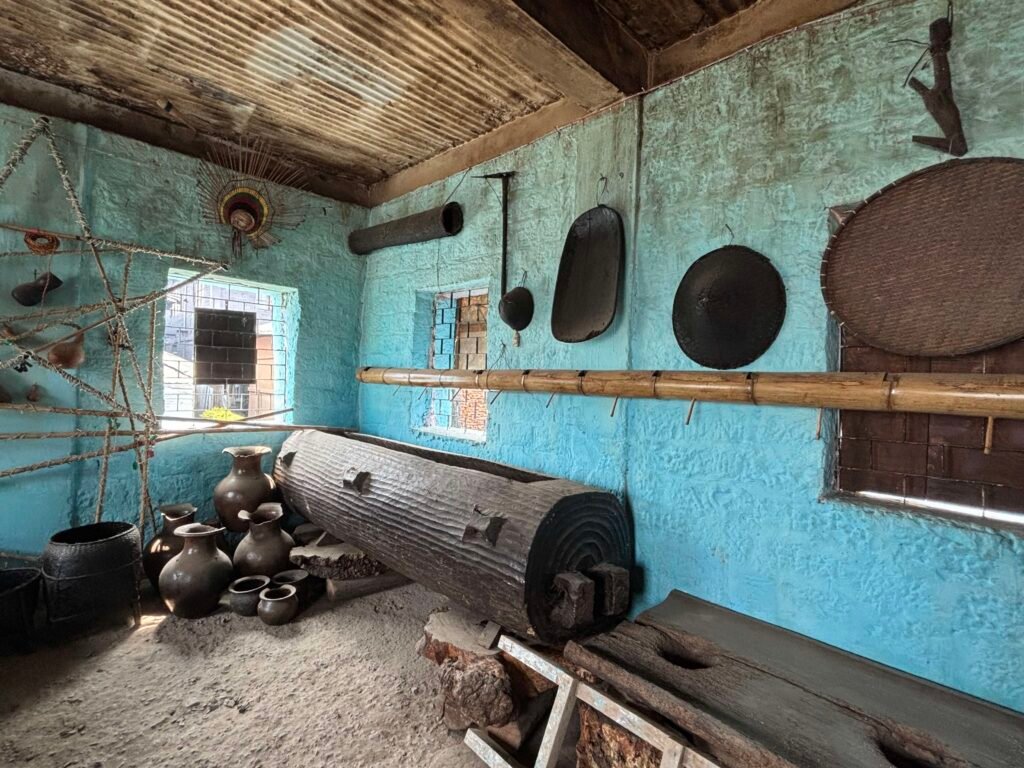
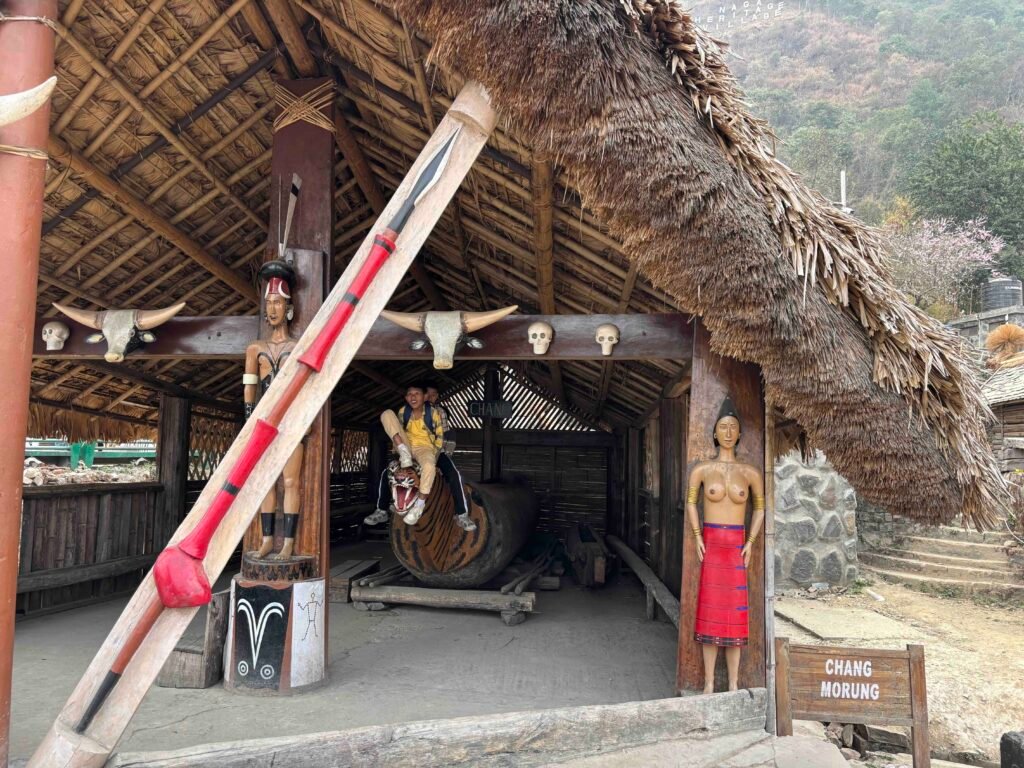
Our last visit is to the site of the annual Hornbill Festival, a local Naga event which was created about 25 years ago to encourage both tourism and preservation of local customs, with each of the 17 tribes having a morung, or community building structure, to display their traditional art, crafts and food. It is a very successful 10-day event in the beginning of December bringing thousands of tourists in each year which our local guide says has helped the younger generation learn about and have pride in carrying forward their heritage. We were there on a Sunday and it was filled with families, local young people and children— the closest they will probably get to a theme park. There is a boat-like wooden structure used as a ceremonial drum that is a common theme in the morungs and the guide pointed out to us that Nagaland is no where near the ocean which makes some hypothesize that the group may have originally come from the waters of Indonesia. The guide never heard of genetic testing but I would think some time in the future the origin of their genes might be known.
Back to our hotel, another delicious meal, and bed.