
I had earlier remarked that I thought the grey atmosphere around Kohima might not be fog but smoke. I was proved wrong today when after our full morning of outings at the Naga village of Khonoma and then the Nagaland State Museum, the sky opened up in a full-scale monsoon rain, unseasonably early we were told, probably a result of global warming. So we all spent a relaxing afternoon, dry and well fed, at our hotel. The rain has now stopped and we hope it will be clear tomorrow for our long drive back into Assam.
Kohima stories continue to amaze. I had noticed upon first entering the city a Beth Shalom ambulance and and later a Beth Shalom Welfare Society Hearse and I wondered how could that be — Jews in Kohima? With research I learned that there is a very small group of Bne Menashe Jews here, who claim they are descended from a lost tribe, who transitioned in the last 40 years from their earlier Christian status to Orthodox Jews and who are earnest about emigrating to Israel. Some believe they have taken on this new identity only in order to emigrate. About 6,000 Bne Menash Jews remain scattered throughout NE India and Israel has made a plan to bring all of them over by 2030. Whether the present deadly conflict changes things is an unknown, as is everything at the moment about the future of the MidEast.-
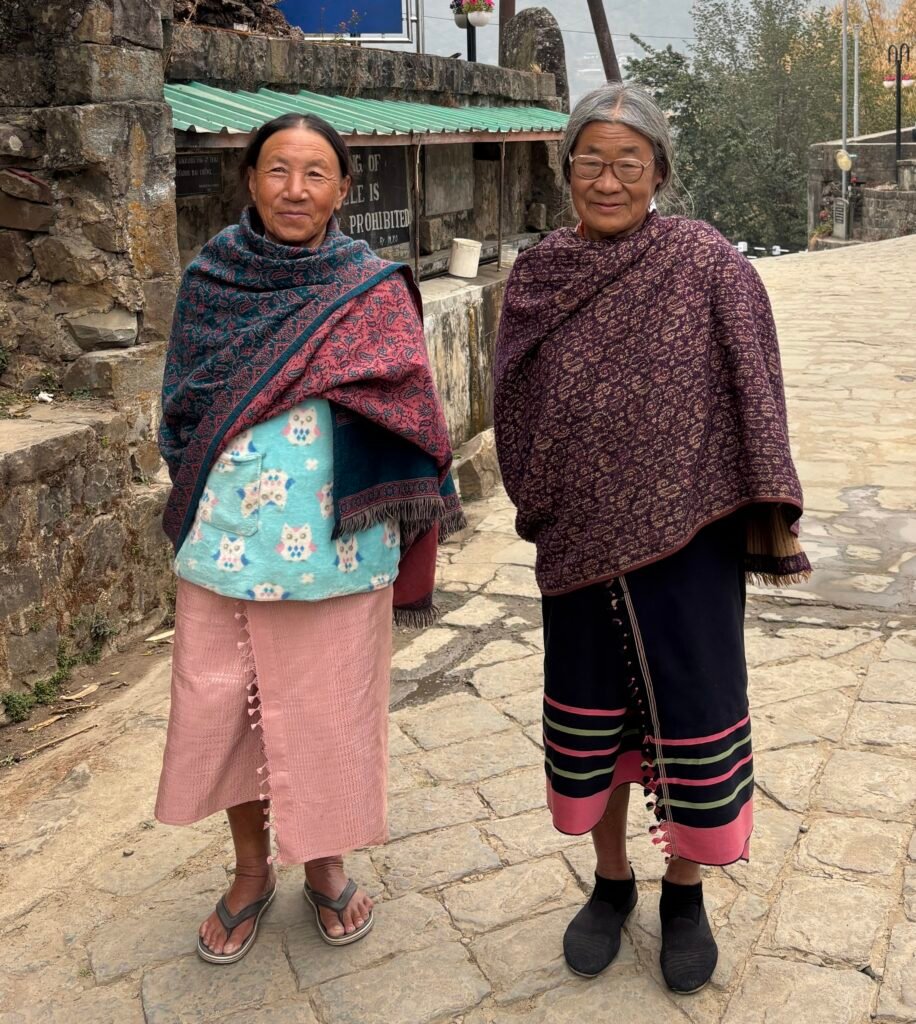
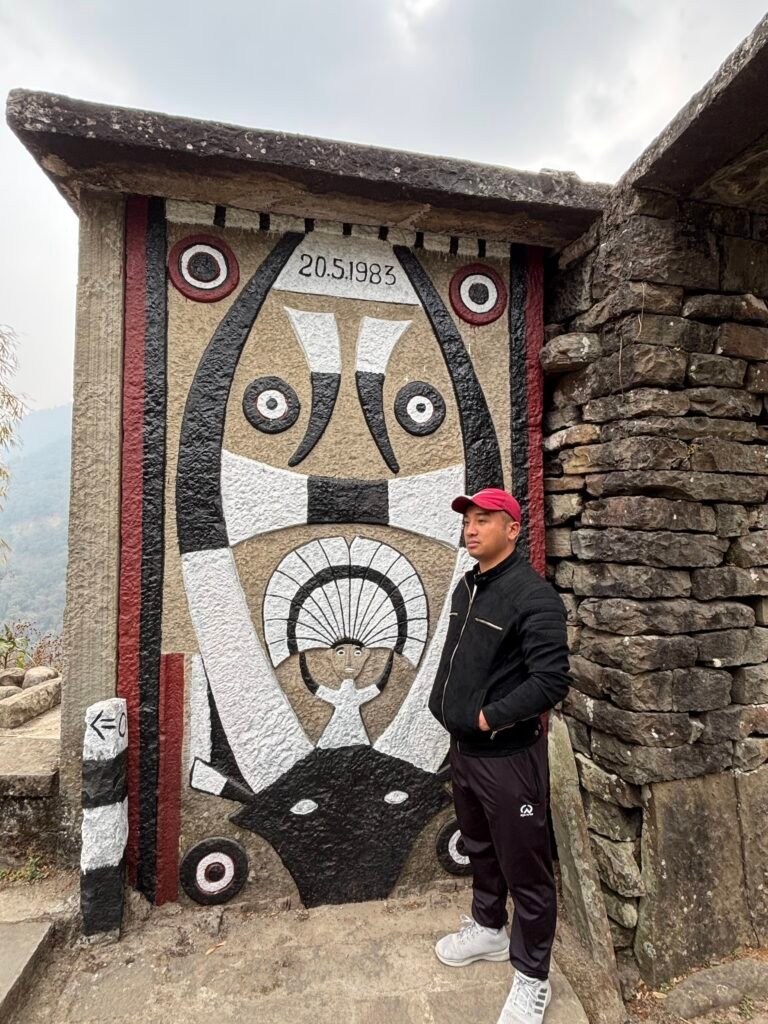
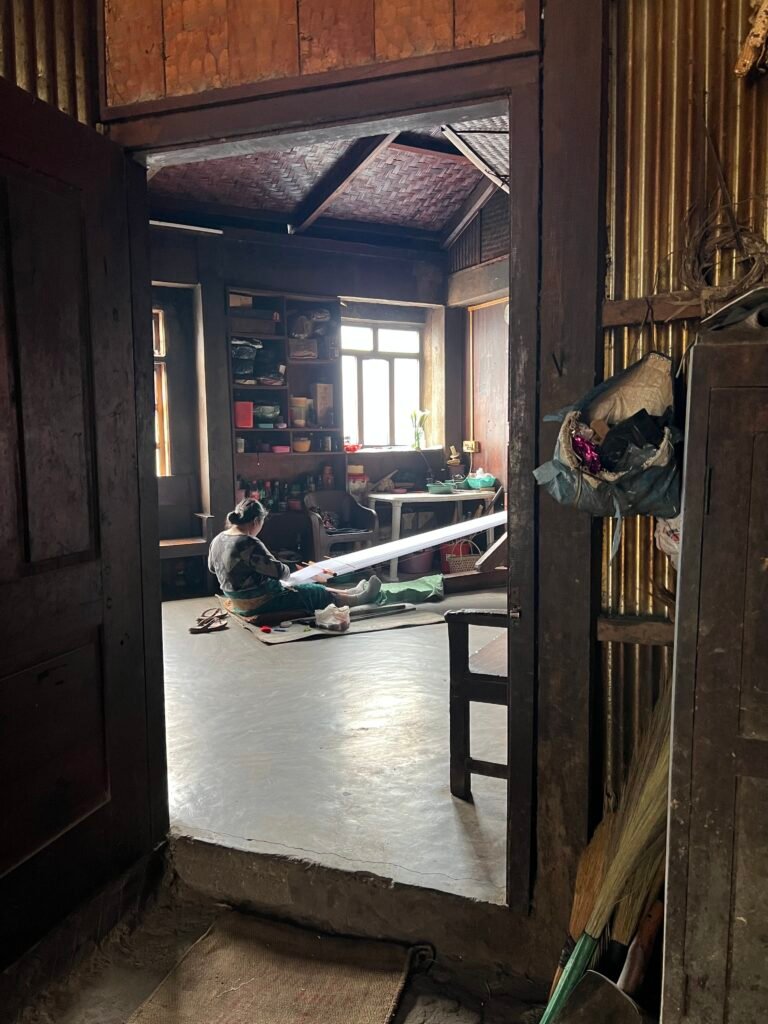
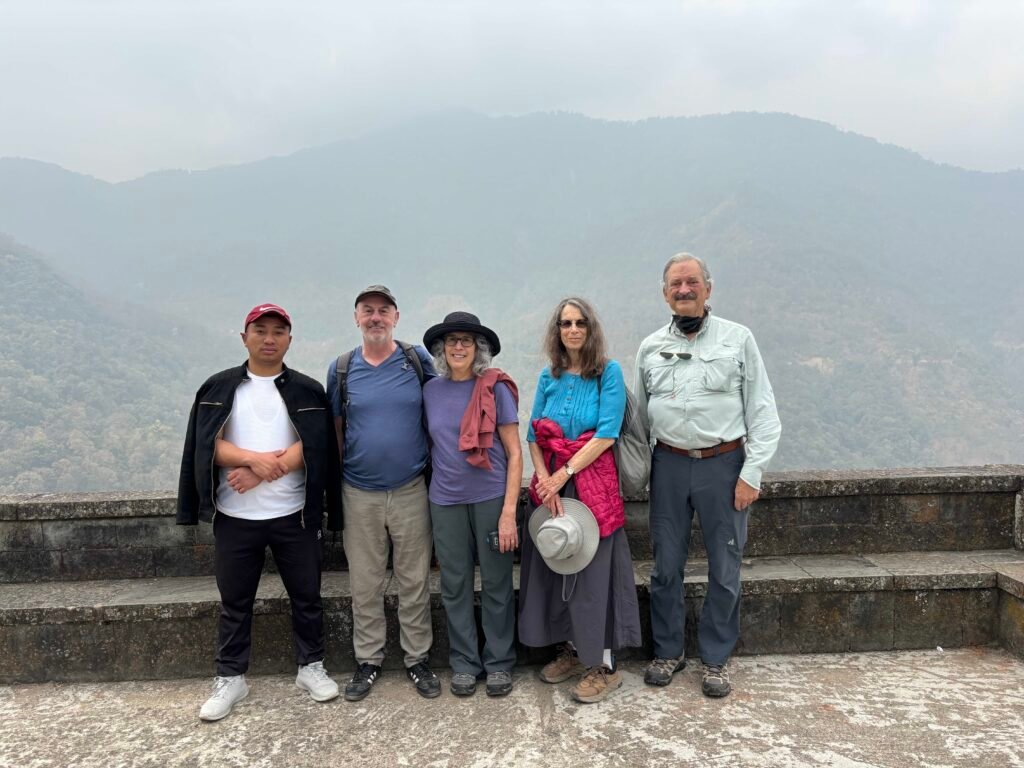
The large village of Khonoma has a well-known reputation on several fronts. As the first and foremost “green village” in Nagaland, both for prohibiting hunting, a traditional main-stay of Naga life, and providing a litter-free environment and secondly and more importantly for its war battles against the British in 1847 which the tribe won. After being vanquished, the British entered a treaty agreement with the this warrior-tribe and left them relatively alone until Independence and their eventual annexation in 1963. The village still extols its past heroes who stood up against the European power, with statues and plaques,. We visited the place where a British commander was shot, leading to the war, as well as to 2 of the 3 forts built and used in defense during the skirmishes.
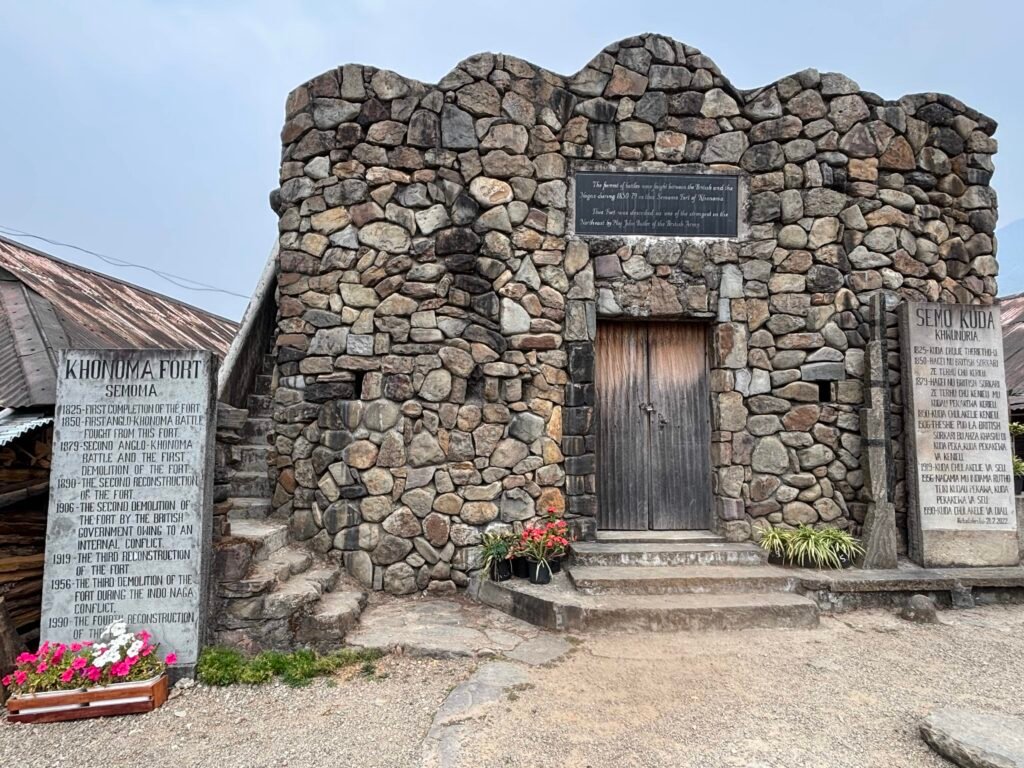
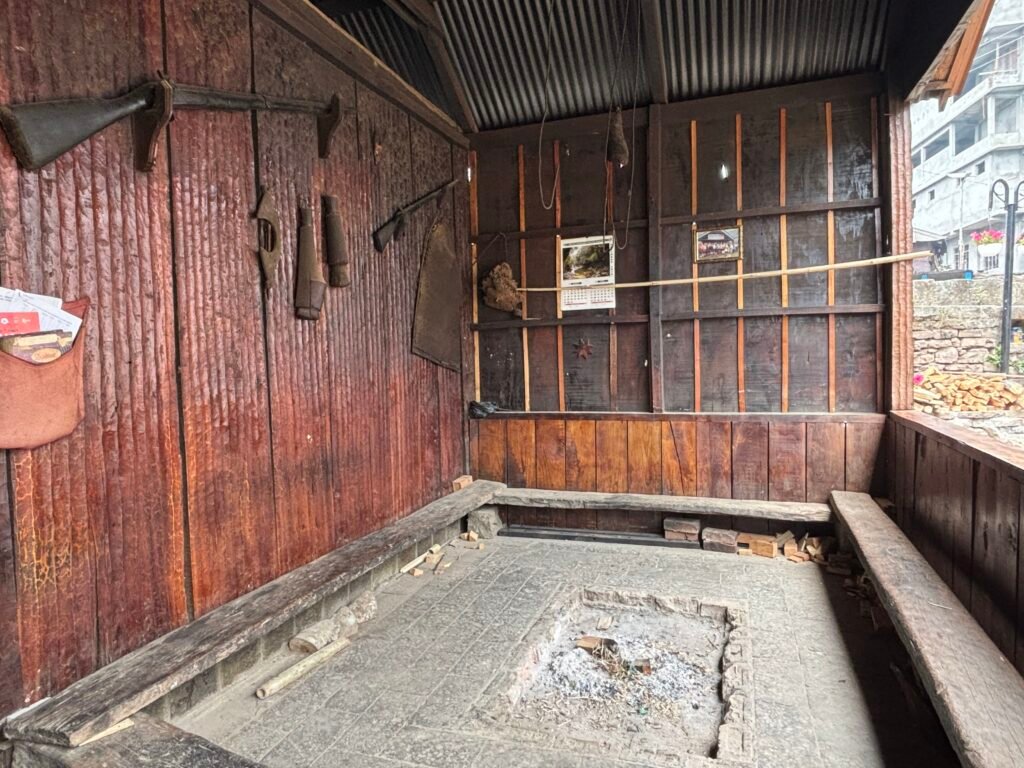
Like most of Naga lands, the village is now surrounded by large swathes of terraced rice fields. There still remains a small outdoor amphitheater and a small indoor meeting place where the elders meet to settle disputes. They offered to take down for us one of the old muskets on the walls below — but the large one weighs about 50 pounds!
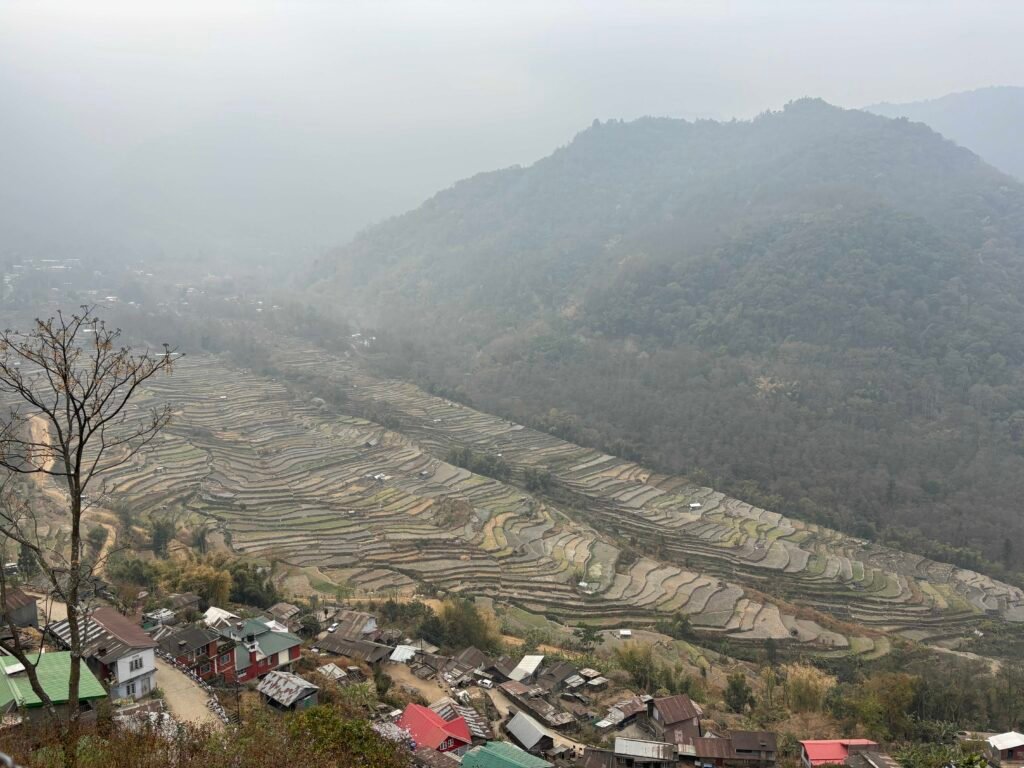
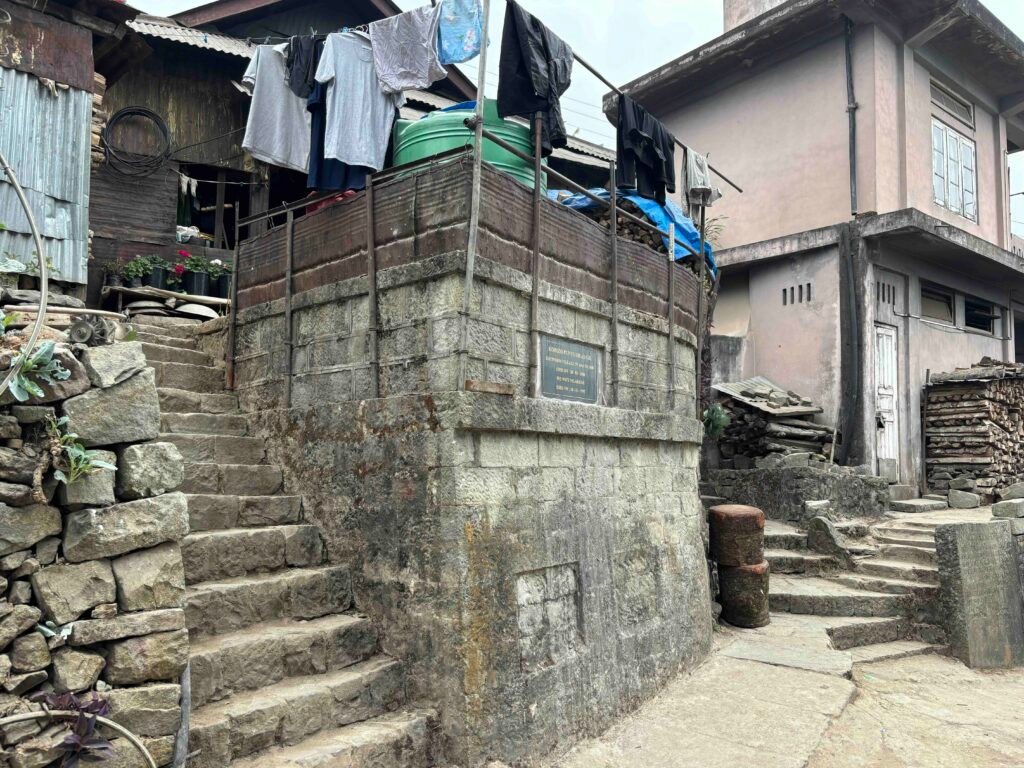
Here, as in most places in this part of India, there are no bannisters or railings to provide support going up and down very high and very uneven stone stops. I used the walls for balance and sometimes the arm of our guide and kept a wish and a hope in my heart that I could manage the day without a fall. Our local village guide took us around the historic areas of his town, with pride in its history, past and present, including the flower pots decorating the public walkways and the vistas looking down on the valley below.
The Nagaland Museum in central Kohima really solidified a sense of how strong – and varied – is the culture of the various Naga tribes. Displays of textiles, various games played, hunting techniques, jewelry, pottery, and various very regional artifacts. Dioramas of traditional Naga village life. At the end, our visit was made memorable by the electricity going out together with the beginning of the downpour with thunder rumbling above as we made our way in the dark to our cars and back to the hotel.
With the sun shining, our drive back into Assam today made apparent, once again, the dichotomy between the world of the Naga tribes and that of Assam. As soon as we descended the mountains of Kohima, the change back to Hindu Assam was apparent not only in the faces of the workers but the dress and general visage of the small villages we pass. The Naga tribes and their descendants look Burmese or Thai and the Assamese look more like central India – with women wearing saris which is not common in more Christian Nagaland. It is understandable that they wanted their own state to fit with their mode of conduct and traditions.
The flat plains lifestyle is also quite apparent in the roadway enterprises and stores. It is hard to pin down with specifics but it feels different, including the first Hindu temples I have seen in the last few days. Bill has commented on how everyone here seems to be an entrepreneur, no matter to how small a degree, creating a stall with only a few things to sell. The populace of a small town in Assam has numerous specialty shops to buy what is needed, a piece of meat here, vegetables there, medicine at one of the many apothecaries on the street, a shirt in the gentlemen’s clothing area, with only a few general stores with a greater choice of goods. Very different from U.S. big city life now — with only big supermarkets and big box stores for our purchases.
Our cars stopped at the town of Bokakhat, which according to our drivers is famous for its sweets and we are given a round lump of a jaggery sweet. We are now rolling by fields of tea, still bright green and ready for picking and we are just about to enter the Kaziranga National Park and Tiger Reserve, although I have heard of their famous rhinos but not their tigers. Our resort is beautifully set within a tropical forest. I am now sitting outside on my porch listening to bird calls from all directions in a heavily forested area. This is the way I imagined Assam. We leave at 5 am tomorrow morning for an elephant safari.
I just saw a large group of Caucasian tourists arrive at our hotel — the first in many days. We are back to a more familiar environment.