Our First Two Days in Tibet
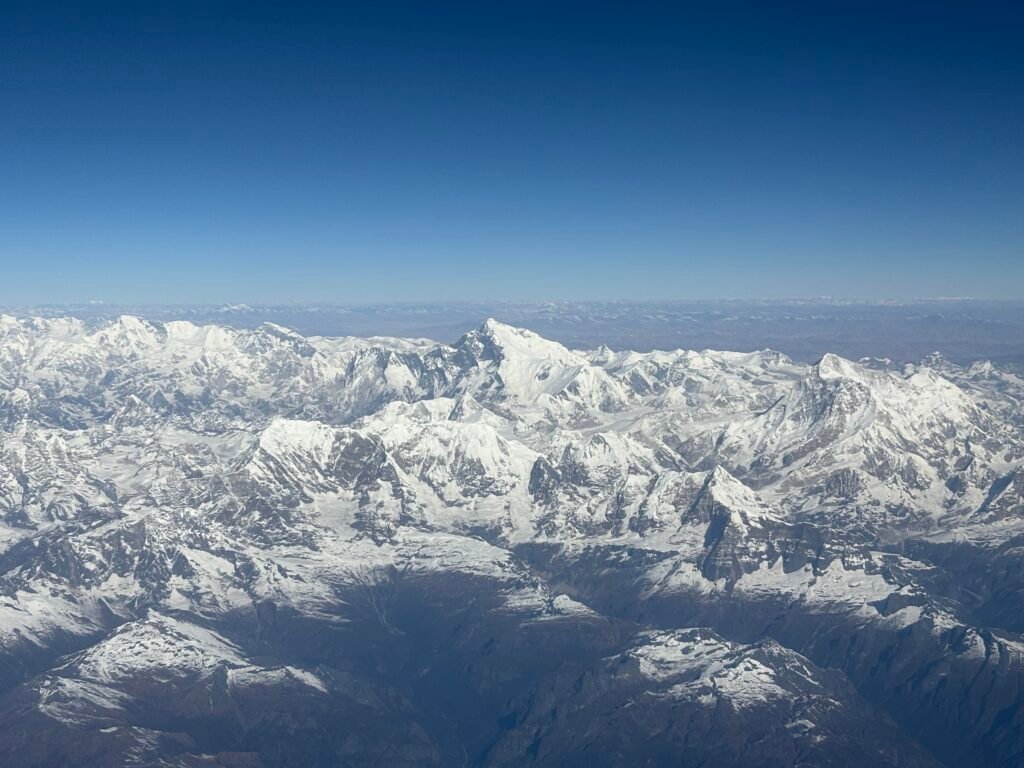
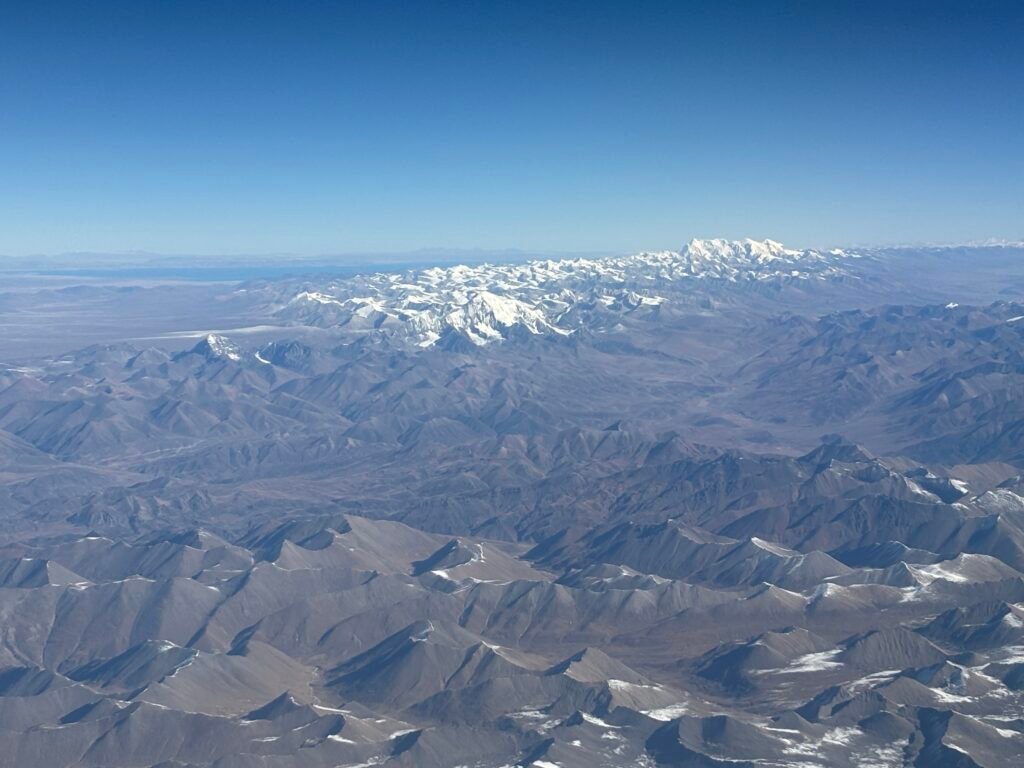
The early morning flight from Kathmandu to Lhasa must be one of the most spectacular short air flights in the world. Flying from the hills of Nepal over the great Himalaya Range with the morning light hitting the earth’s highest snow-covered peaks, including Mount Everest, is incredibly awe-inspiring. Bill and I are flying on a Himalaya Airlines 1.5 hours flight which departed at 8:30 AM. Once over the high peaks, I see below us the great plateau of Tibet, brown and dry, with large and small mountains crenelating the large expanse. With only a dusting of snow on the tops of some mountain peaks but with other snow-covered significant mountain ranges in the distance. There are large and small rivers running through the plateau at the base of the mountains with no signs of habitation anywhere although I did see a field of what looked like wind turbines somewhere down below. The hills become gentler as we approach Lhasa with a farmers field here and there. We are starting our descent into Lhasa so I must put away my laptop.
I have been in Tibet for 2 days now and it has been a strong experience. I am feeling fine, a little strange on our first day, but I have adjusted well to the altitude as our hotel pumps oxygen into all the guest rooms which, together with my diamox medication, is mitigating the impact of the 11,974 foot altitude. Going to Tibet has been a long dream of mine, planned and then cancelled during COVID times and I am amazed I am here. Bill feels the same. We did nothing our first afternoon but rest in our rooms to help us acclimatize. We are the only non-Asians In our very good hotel which does not even have its name in Roman alphabet written on the outside, Chonqui Oxygen-Rich Hotel.
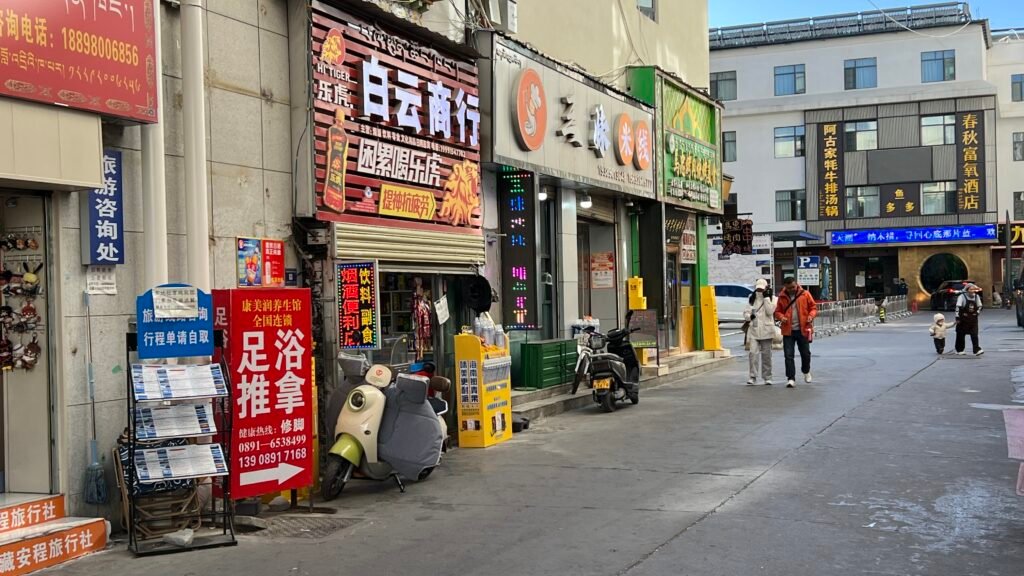
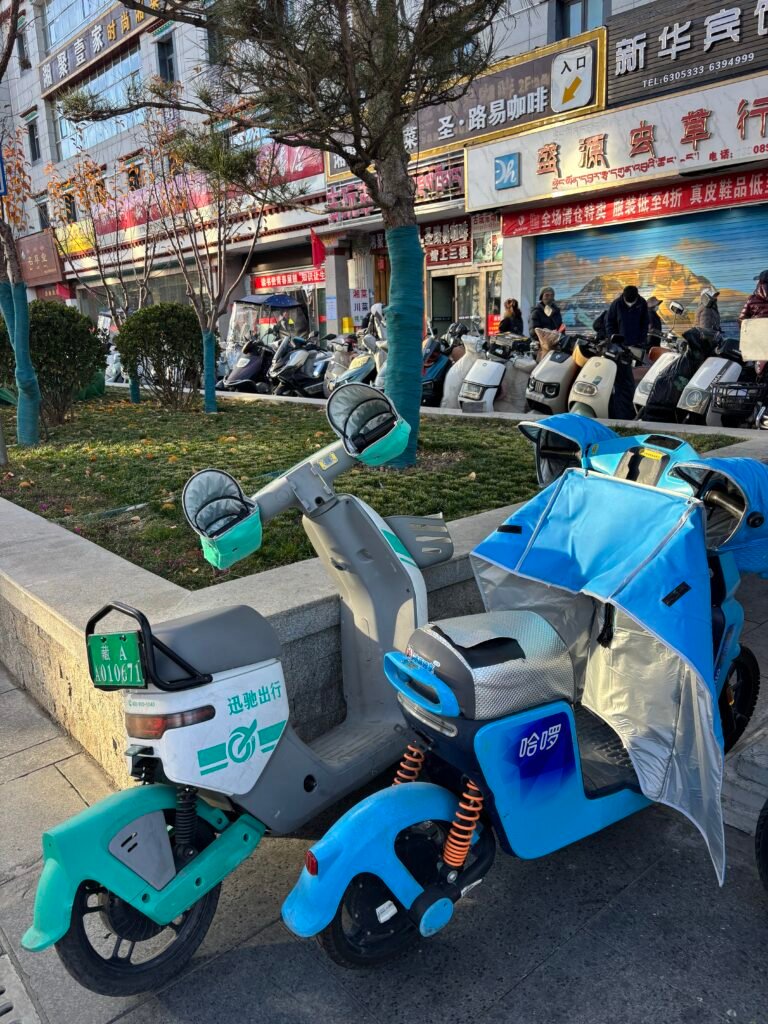
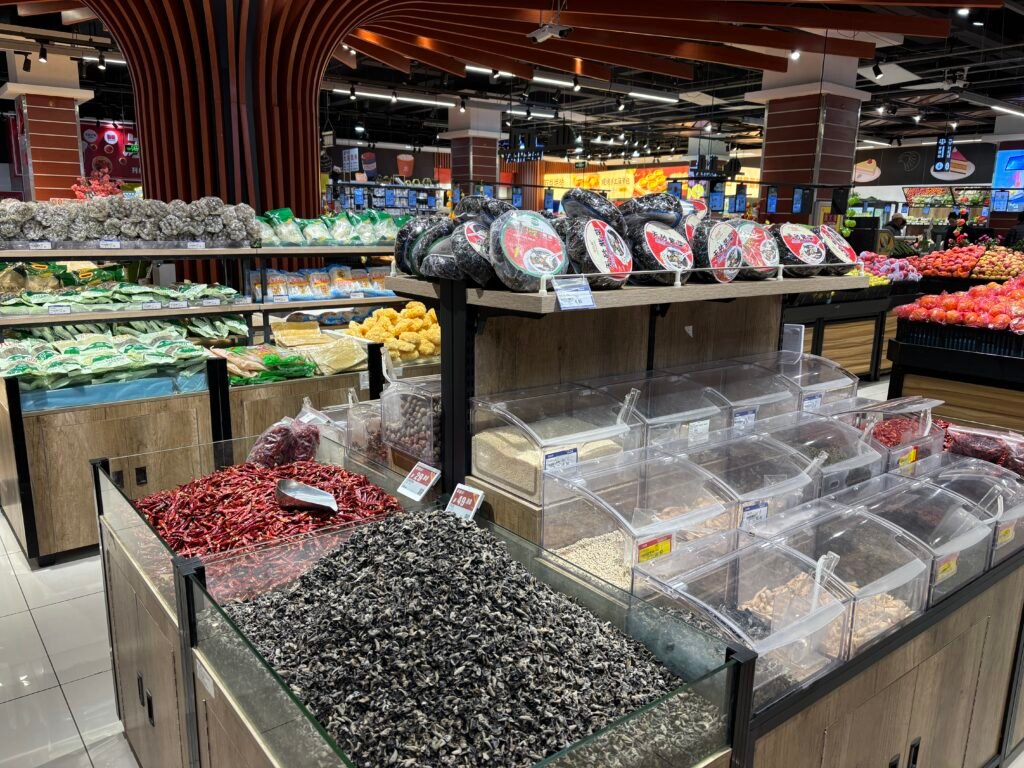
My first impression is that this is a very Chinese newly-built city. There is little Tibetan about it. Driving in from the airport are sleek industrial buildings as well as tall high rise apartment complexes. In the center of town, there are long straight streets with new lotus shaped street lamps including security cameras and 5 story buildings with uniform facades with cameras on top. Wide streets with quiet electric cars and even quieter motor scooters. In the area where we are located, the streets are lined with high-end name brand clothing stores from all over the world: Mont Bell, Camel, Hush Puppy, North Face, Arcteryx, Qiaodan (which is Chinese for Michael Jordan apparel). And the prices are very high, similar to the U.S. even though most products are probably made in China. As a very regional product, many stores in this tourist area are selling a large variety of dried mushrooms I can not identify as well as the very expensive Cordyceps Sinensis (a fungus that grows inside a caterpillar) and Tibetan red saffron. These items appears to be a major sales item sold to visitors from China.
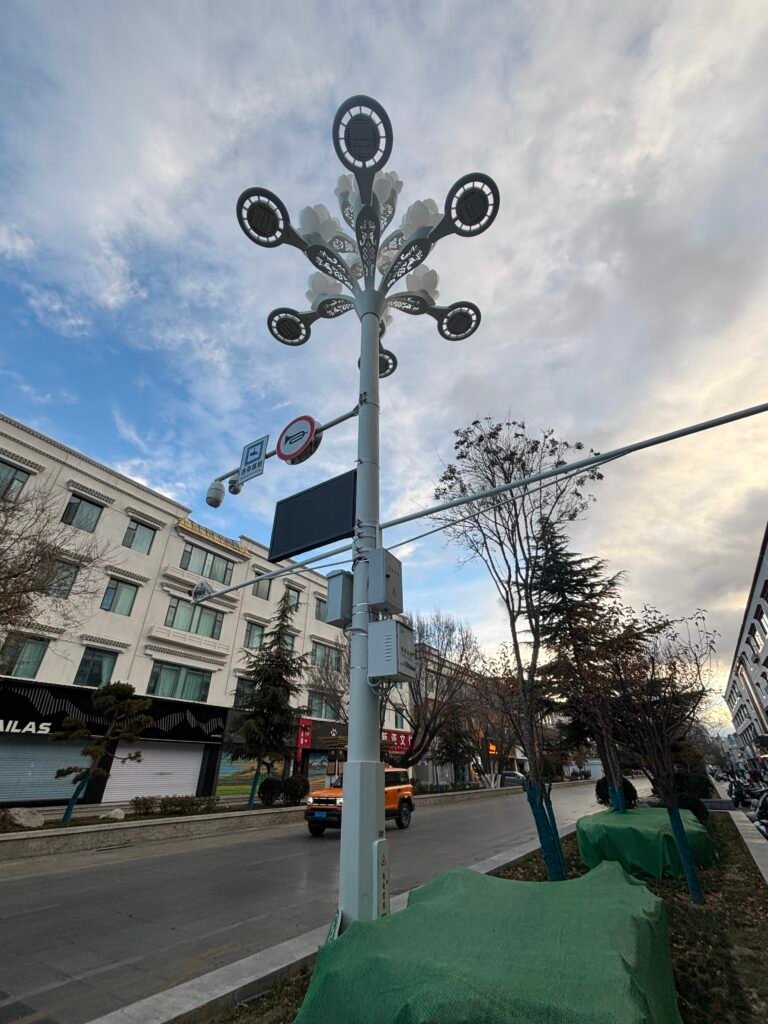
Nobody speaks English and very few signs are in English, including in the high end stores. Very few signs are even written in Tibetan script. Large Chinese characters are splayed across the sides of mountains although none of the older Tibetan population knows what message is being conveyed. More than 1/3 of the population in Lhasa is Han Chinese after 40 years of immigration from the Mainland with a much lower percentage in the countryside but Chinese is the language now taught in schools. So although our 45 year old guide can not read Chinese, his 12 year old son is able to do so. In effect, Chinese culture has overwhelmed the indigenous Tibetan way of life and the Chinese government now feels so secure in its position that it is more comfortable allowing the Tibetan people to express and practice their form of Buddhism.
It seems to me that the Chinese Government has done an excellent job raising the standard of living of many of Lhasa’s inhabitants. But it has done a much less admirable job supporting the local Tibetan culture Both Bill and I have been thinking about this as we walk around a city with both stylish Chinese visitors in jeans and labeled clothes and Tibetans in traditional dress, women with long dresses and colorful striped aprons, men with long sleeved jackets and sometimes cowboy style hats. Women wearing braids across the top of their heads platted with colorful ribbons and older men with a single thin braid in the back. I remarked to Bill this afternoon that a fairly large number of Tibetan women seem to have limps and use canes or are very bent over. Somewhere we had heard that their hard life makes a 40 year old here equal to a 60 year old in the U.S. The extremely dry atmosphere is very harsh on the skin. But the main thing we were considering was whether we, who have never had to go hungry or watch our children cry from lack of food, are in any position to say that the Chinese government has done poorly by providing shelter, food and education to the people of Tibet.
On the dark side, I recognize the genocidal sterilization and health care provided to Tibetan women in the earlier days of Chinese repression, of the willful destruction of monasteries to cut the cord of obedience to religious leaders, and the purposeful evisceration of a culture and its language, with enforced silence about the political drama that unfolded to bring the Tibetan people to its knees. When I recognized an historical untruth being forwarded by our Tibetan guide, Pema responded that was “political” and could not be spoken about. The name of the present Dalai Lama is never said out loud. Bringing in a photo of him is illegal. When I mention to Pema my several experiences meeting His Holiness, he hushed me and looked quickly around to see if I was overheard.
I see how the young people in Lhasa, well dressed on their motor scooters, are enjoying life. They seem to live with a degree of comfort and security. This is their reward for obeying the government imposed rules but this choice needs to be balanced against freedom of expression, congregation and religion. It is not an easy equation and we are still searching for it in the U.S.
Our first full day I go out by myself for a walk in the morning and end up in the Lhasa Department Store, which includes many separate shops and a major supermarket with all kinds of food including fresh fruits and vegetables, probably grown in the local greenhouses. I accidentally leave by another exit and get completely lost. I have a good sense of direction so this is very unusual for me, perhaps impacted by my low oxygen level (my oximeter read 88 this morning) and by the fact that all the straight new streets look alike here — with the same name brand shops.
I ended up walking for 3 hours and, out of necessity, discovered that there are many, clean public toilets in the city each with a dedicated cleaning attendant. However, all, except those few for the disabled, are squat toilets, very difficult for me. The sun was shining and I was warmly dressed and enjoying the new sights and sounds. But my Google Maps did not work (Google is persona non grata in China) and I did not have the address of my hotel. Eventually I was able to message Bill who sent me the name of our hotel and a small map of its location, in Chinese, which turned out to be extremely useful. I stopped and asked a number of policemen but they dismissed me for lack of a way to communicate. There was one lovely Tibetan woman in an antique store who took me over to a security guard at a nearby temple and he tried to explain to me which way to walk but I ended up going in a big circle. I now had only 30 minutes to get back to our hotel to meet our guide for our afternoon outing and I told Bill by text message that I might just have to find a hotel and wait for our guide to come pick me up. But when I ran across the same security guard who had tried to give me directions an hour before, he kindly said he would take me to where I wanted to go. I was actually only about 10 minutes away and he was going that way to have breakfast at the police canteen and accompanied me. I just made it back in time to meet Bill and our guide for our outing. I was amazed that with all that walking, I was not out of breath or even very tired. Perhaps running on adrenaline .
After lunch together at what Pema called a mid-level restaurant (which I think means there was a waiter who spoke some English), Pema hired a taxi and we drove to Sera Monastery, formerly one of the most prestigious academic centers for Buddhist study in Tibet. The most important was Ganden Monastery which was completely destroyed by the Chinese. Sera suffered some damage from artillery in the 1959 takeover and far more serious impact from the cultural revolution in the 60’s and 70’s when zealous Maoists looted its religious artifacts and destroyed one of the greatest extant Buddhist libraries. Our guide glossed over this history. At one time there were over 5,000 monks living and studying at Sera — now there are about 600 monks, authorized by the government, which is more than I was expecting. Young men now may not join a monastery until they are 18 greatly changing the traditional academic composition and teaching methods.
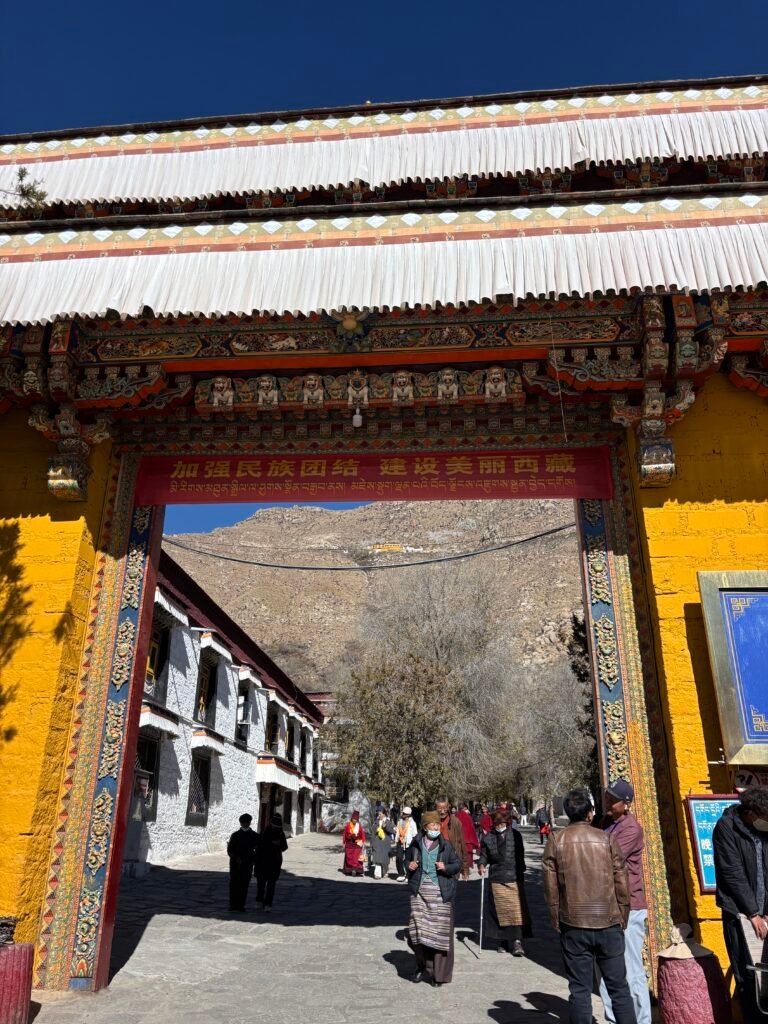
We are at Sera to attend the debate session between the monks which I have previously heard and read about: Students try to explain certain Buddhist philosophical concepts which they recently learned from their teachers. The stand across from other students and express themselves with ritual hand movements and their partner, sitting on the ground, critiques their arguments. In my prior understanding, this was a one-to-one exhibit of knowledge. But when we arrived we were met with hundreds of monks paired off and debating with each other in a roped-off enclosed outdoor area with the senior teachers in a slightly separate section. There were many tourists, although few from outside Asia, circling around but we stayed long enough that the crowd dissipated while the debates went on. Bill notes that the cacophony of voices coming from hundreds of monks debating at the same time was soothing and mesmerizing.
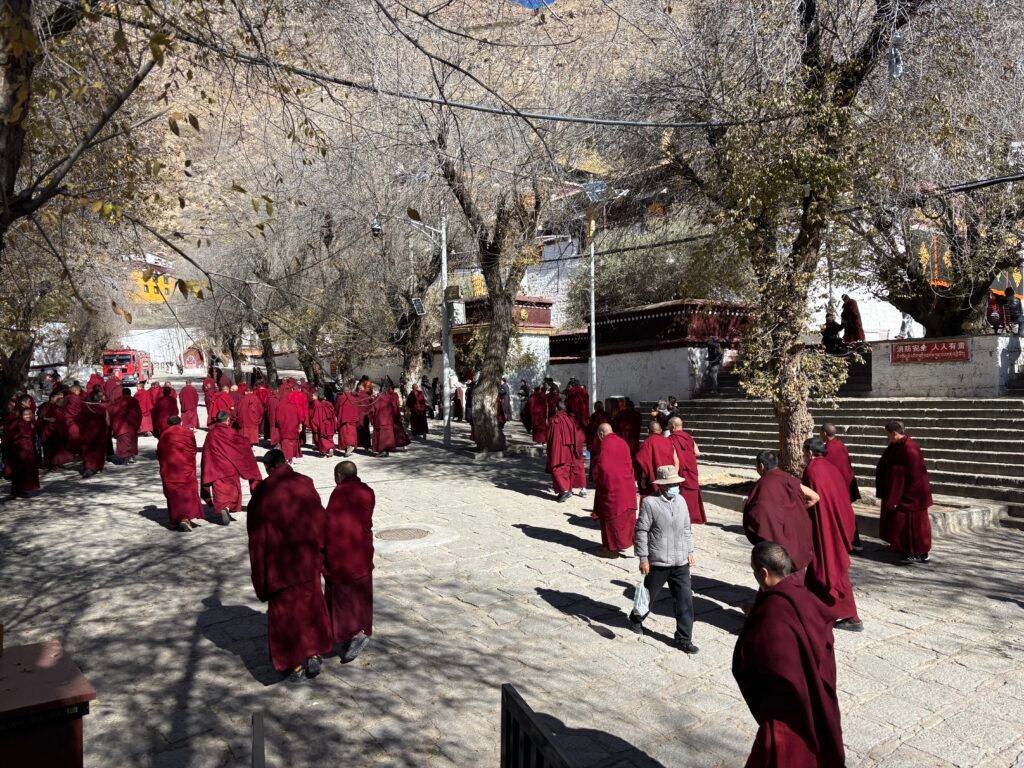
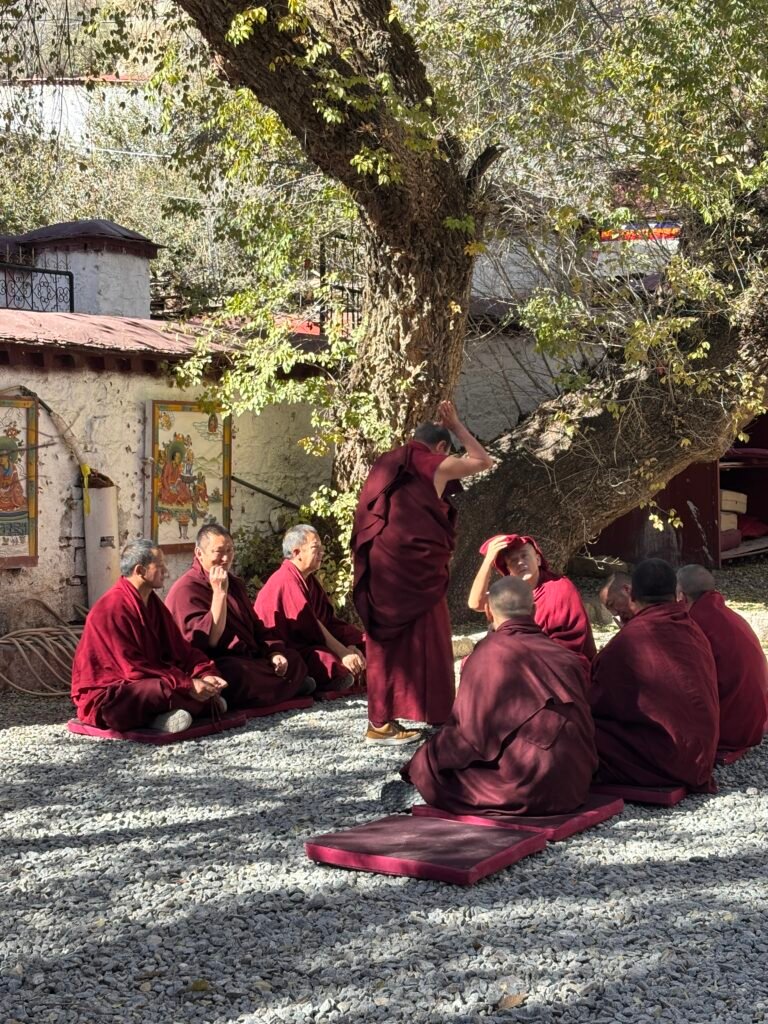
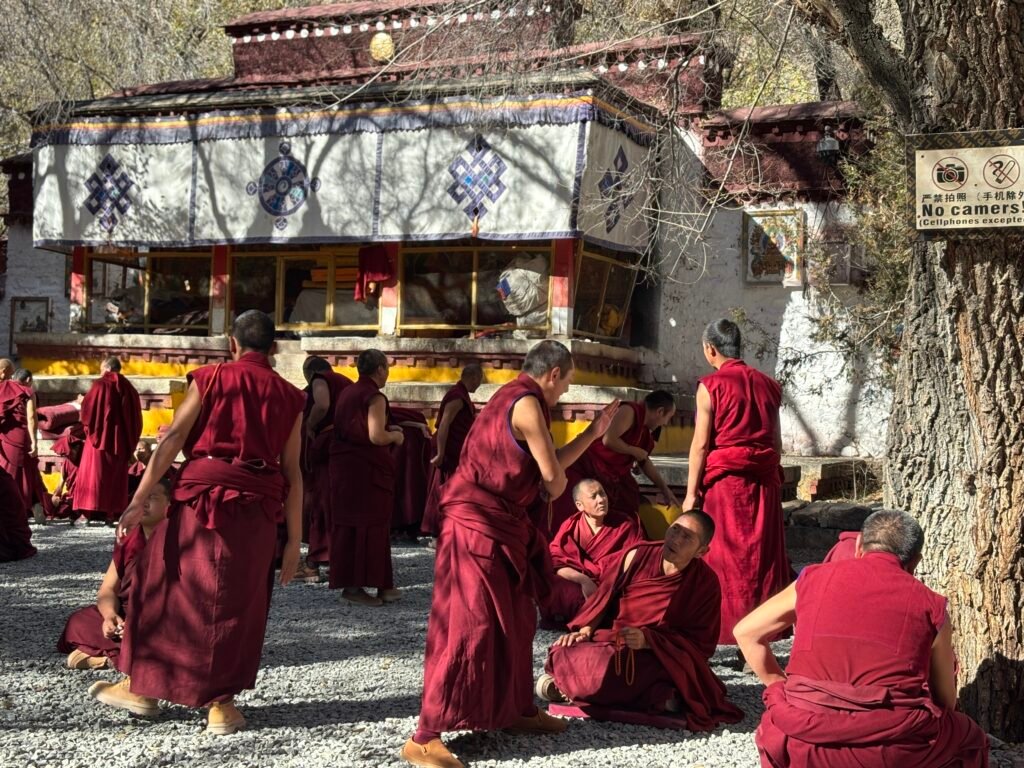
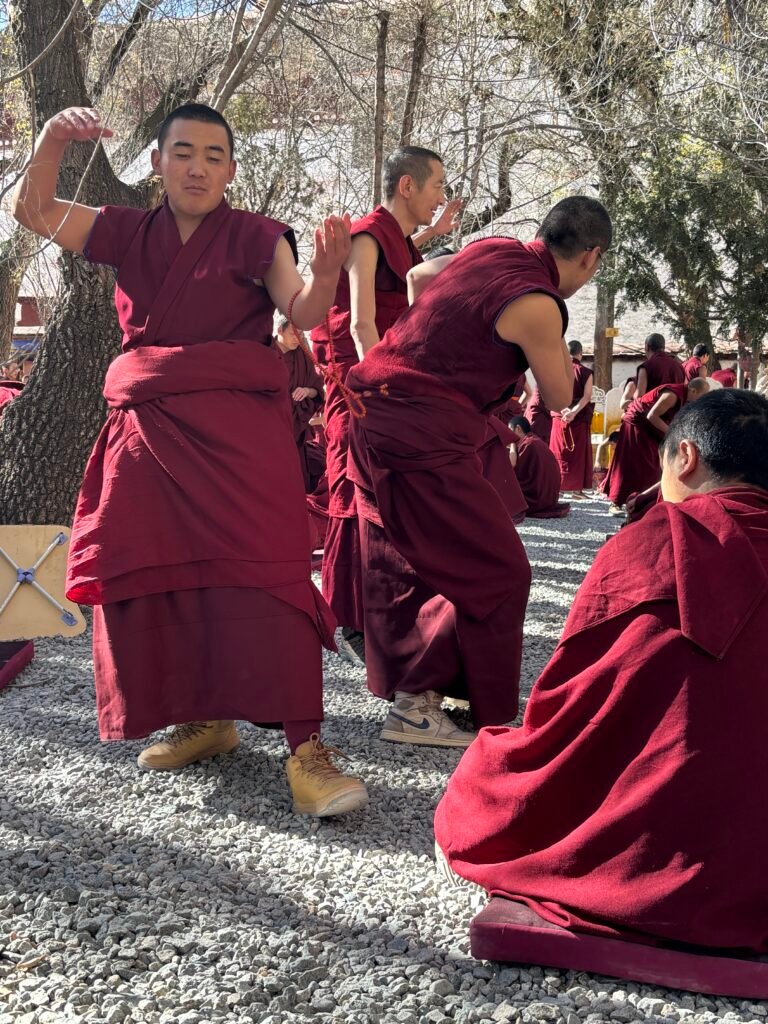
The Tibetan women coming to observe this ritual and pray in the prayer hall are beautifully dressed with long wrapped dresses, multi-colored silk striped aprons, and traditional turquoise and amber jewelry. One group wants to have a photo taken with Bill, which he obliges. The main prayer hall is a very large space with seating for all the monks. There are paintings on the walls of Shakyamuni Buddha and great brocade hangings from the ceiling. The main alter has a photograph of the last verified Panchen Lama who died in 1989 and the current controversial Panchen Lama, chosen by the Chinese Government after the boy recognized by the Dalai Lama was abducted and never seen again.
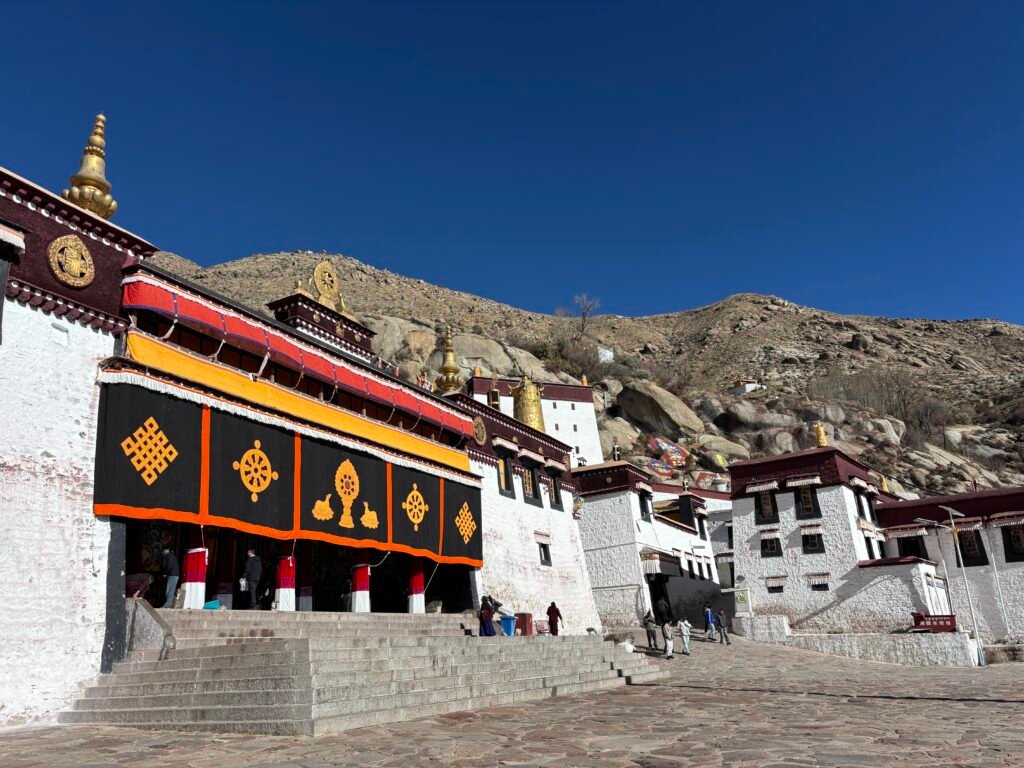
What is very surprising to me is that in Chinese Tibet shoes are not taken off when entering prayer halls. I first thought it might be from political policy but I asked Chat GPT which could not find documentation to substantiate that theory. It appears to be a difference in climate and traditional practices.
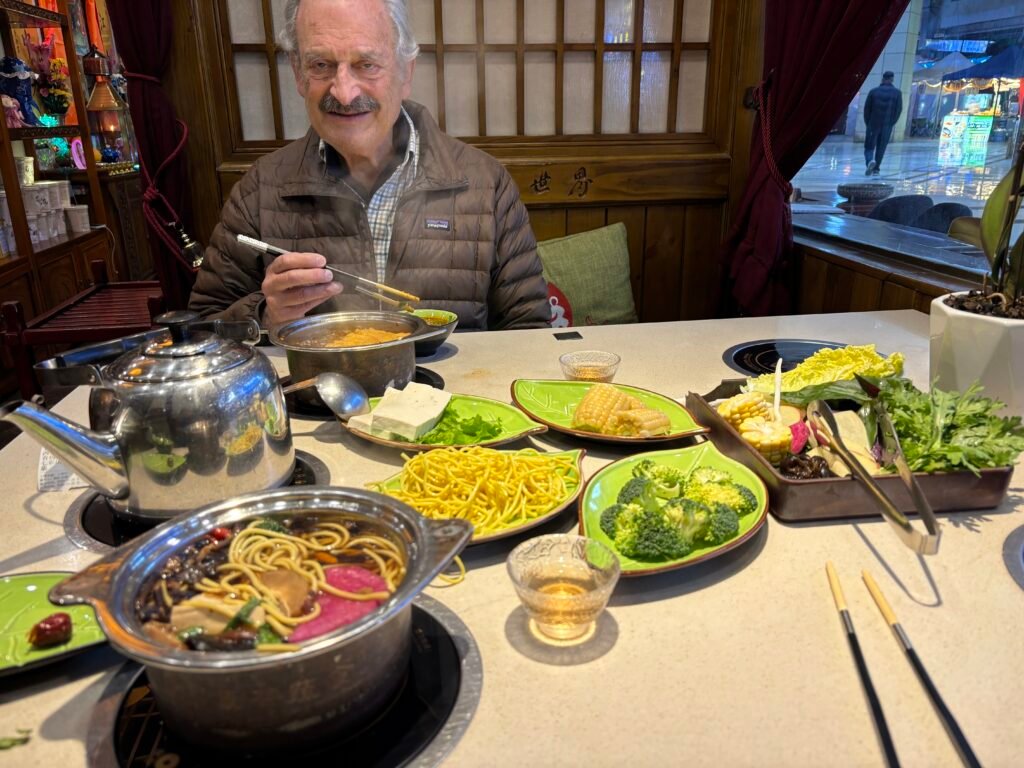
Exhausted from the overwhelming sensory input and the altitude, Bill and I enjoy dinner at a vegan hot pot restaurant which we discovered in a bright new shopping mall next door to our hotel. We communicated with the waitress, as we have been doing everywhere, through a translation app everyone has on their mobile phones. While we ate, we heard very loud singing and music coming from at least two nearby restaurants, young people enjoying themselves with professional singers and karaoke on a Friday night . Not our style of music and dance but it was good to see people laughing and clapping, supported by beer and friends.
Tomorrow we go to the Potala Palace and Jokhong Monastery in Lhasa.